By Estate HDR Team | Published: Nov 2026
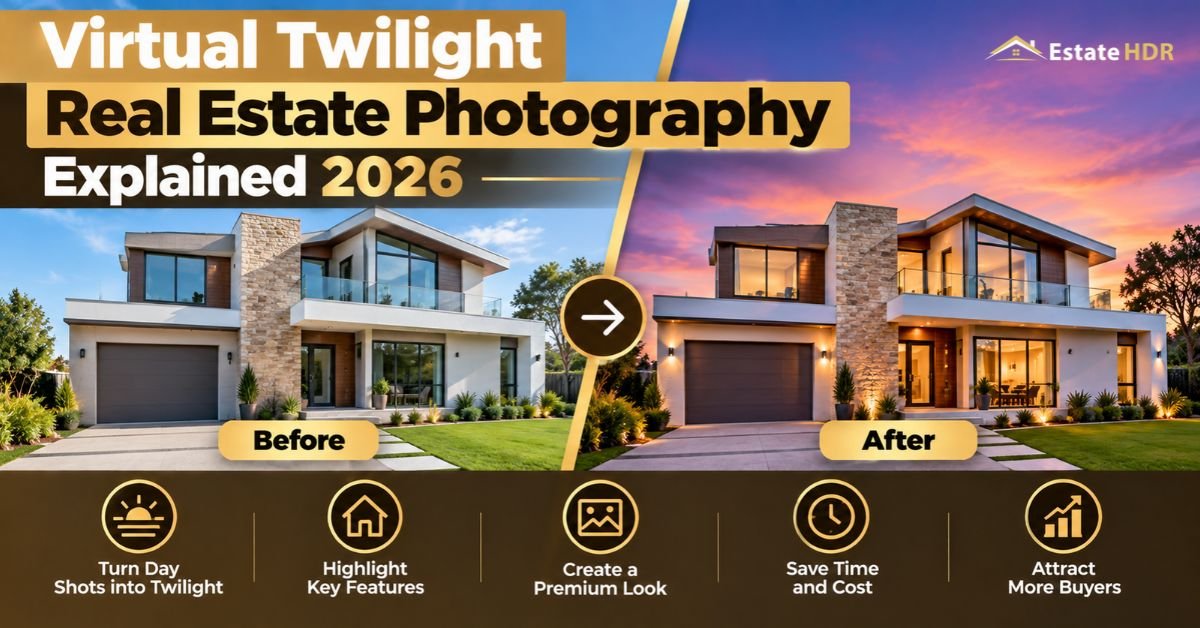
Scroll any portal and the twilight frames stop you. Warm windows, deep blue sky, a lit path up to the door. They look like the house is waiting for someone. Almost none of them were shot at dusk. This is how virtual twilight real estate photography is actually built, step by step and what separates a convincing one from the version buyers spot immediately.
Quick Answer at a Glance
Question
Short answer
What it is
A daylight exterior rebuilt as an evening scene
Rate
$6.00 per photo for virtual twilight. $4.00 for day to dusk
Turnaround
24 hours
Best source frame
Front elevation, flat overcast light, sky visible above the roofline
Worst source frame
Hard midday sun with strong shadows
How many per listing
One. It works because it stands out
Legal note
Materially altered image. Disclosure required in most markets
The Six Steps Inside a Conversion
Studios describe this as one service. It is six operations and the price difference between suppliers usually comes down to how many of them actually happen.
Step one: the sky
The existing sky is masked out and replaced with an evening gradient. Deep blue at the top, warmer near the horizon. The gradient has to sit at a brightness that suits the exposure on the house.
Masking quality decides everything downstream. Bare branches, railings and aerials are where cheap work falls apart, as covered in the sky replacement article.
Step two: the ambient drop
The whole frame is darkened to evening levels. Not uniformly. The sky side stays brighter, shadow sides go deeper, the overall colour cools.
Skipping this step is the most common shortcut. A brightly lit daytime house under a dusk sky is the version everyone recognises as fake.
Step three: interior window glow
Every window that should be lit gets treated individually. Warm light, slightly uneven, with a sense of a room behind the glass rather than a flat orange rectangle.
Uniform windows are a giveaway. In a real house some rooms are lit, some are not and curtains change the colour of the glow.
Step four: exterior lighting
Porch lanterns, path lights, uplighters on trees, anything already fitted to the building. The rule is that only existing fixtures get switched on.
Adding landscape lighting the house does not have crosses from presentation into misrepresentation. A buyer arriving to find no path lights has been sold something the property does not include.
Step five: reflections and surfaces
Driveways pick up window light. Pools hold the sky. Glass doors reflect what is behind the camera. These are the details that make a conversion read as a photograph rather than an illustration.
Step six: the final grade
Colour is pulled together across the whole frame so the warm interior light and the cool exterior sky belong to one scene.
Finished examples are in the twilight examples. Look at the windows first. That is where the work shows.
What the Conversion Costs
Priced per photo rather than per visit, which changes the comparison completely. Estate HDR lists virtual twilight service page work at $6.00 per photo and day to dusk at $4.00 per photo, both inside a 24 hour turnaround. Per-unit rates for every service sit on the published pricing block.
Set that against a real twilight shoot. A second visit to the property, timed to a twenty minute window, with travel, setup and the risk that cloud arrives at the wrong moment. For most listings the arithmetic is not close. The exception is a flagship property where the budget supports a genuine evening shoot. Real light still beats a conversion when the photographer is good and the weather cooperates.
Twilight Against Day to Dusk
These two names get used interchangeably. They are different products at different prices.
| Feature | Day to dusk | Virtual twilight |
|---|---|---|
| Time of day produced | Golden hour, sun just set | Blue hour, deeper evening |
| Sky | Warm orange and amber | Deep blue with warm horizon |
| Mood | Warm, inviting, suburban | Dramatic, premium, architectural |
| Suits | Family homes, standard listings | Luxury, glazed architecture, pools |
| Rate | $4.00 per photo | $6.00 per photo |
Both start from the same daylight frame. The day to dusk conversion page covers the warmer version. Pick by the house rather than by preference.
Which Homes Suit It
The conversion works where there is something for evening light to reveal.
Large glazed areas are the strongest case, since the window glow does most of the work. Landscape lighting is the second, because the fixtures are already there waiting to be switched on. A pool reflects everything and doubles the effect. Homes above the local median benefit because buyers at that level expect production values.
Weak cases: small apartments with no outdoor space, terraced houses with a single front window, any property where the exterior is not the selling point. Converting those produces a dark photo of an ordinary building.
Real Shoot Against Conversion
Worth being even handed about this, since the honest comparison helps a reader decide. A real twilight shoot captures light that behaves correctly everywhere at once. Reflections, shadows, the way glass holds the last of the sky. No conversion matches a good one.
What a real shoot also brings: a second trip, a fixed twenty minute window, dependence on weather and a photographer standing in the dark hoping the seller remembered to turn the lights on. Reschedules are common. The craft side of shooting one is covered in the twilight photography guide. Read it before deciding that conversion is always the answer.
The One Frame Rule
Here is the advice most studios will not give you, because it reduces the order size.
- Use one twilight frame per listing. The hero exterior. That is it.
It works because it is different from everything around it. In a thumbnail grid of daylight listings, the lit house stands out. Convert the whole gallery and that advantage disappears, since the contrast was the point.
- A second twilight frame is defensible when a property has two strong elevations, a front and a rear garden view. Beyond that, the gallery starts to look like a brochure for a house nobody lives in.
Why the Twilight Frame Earns Its Place in the Gallery
Worth understanding the mechanism, since it explains the one frame rule and the price. A portal shows listings as a grid of thumbnails. Every competing home in the area was photographed in daylight so the grid is a wall of pale blue sky and beige walls. Sameness is the default condition of property search.
A lit house at dusk breaks that pattern. The eye goes to the brightest warm point in a field of cool tones without the viewer deciding anything. That is physiology rather than marketing. The second effect happens after the click. A twilight hero sets an expectation of care and the daylight frames that follow get read more generously. The same gallery without the hero gets judged on its weakest frame instead.
"Both effects depend on the twilight frame being rare. In a market where every listing has one, the advantage disappears. That is worth watching locally rather than assuming it lasts forever. "
Timing It Against the Listing Schedule
The conversion is fast. The planning around it is where listings slip. Work backwards from the go live date. Photos shot Tuesday, edited and returned Wednesday, twilight conversion ordered Wednesday, back Thursday, listing live Friday morning. That sequence holds comfortably on a 24 hour turnaround.
The failure case is ordering the twilight frame as an afterthought on Thursday evening, which pushes the hero image past the listing launch. A listing that goes live without its best frame rarely gets it added, because nobody wants to refresh a listing two days old. Order the conversion at the same time as the main edit. One upload, one instruction, both back together. Estate HDR takes the twilight instruction in the same order notes as the editing brief, which is the simplest way to keep the two steps on one clock.
What Sellers Say When They See It
Two reactions come up repeatedly and both are worth preparing for.
- The first is delight followed by a question about whether it is allowed. Answer with the disclosure line before they finish asking. Sellers relax immediately when they learn the practice is standard and labelled.
- The second is a request for more. Once a seller sees their house at dusk they want the rear elevation, the garden, sometimes the kitchen. This is where the one frame rule needs explaining rather than simply applying, since the seller reads a refusal as the agent saving money.
The explanation that works: the frame stands out because it is the only one. Fifteen of them look like a brochure and buyers stop believing any of it. Said plainly, sellers accept it.
What Goes Wrong Most Often
Four failures, in the order we see them.
- The house was never darkened. Daylight building, evening sky, instant giveaway.
- Windows all glow the same flat orange with no sense of rooms behind them.
- Lights added that the property does not have, usually landscape uplighting.
- The driveway and lawn stayed daylight green while everything above them went blue.
All four come from treating the sky as the job. The sky is step one of six.
Disclosure, Plainly
A twilight conversion is a materially altered image under most MLS rule sets. One line in the caption handles it.
Sellers occasionally push back, worried it undermines the photo. It does not. Buyers who book a viewing are coming for the house, not the sky. The agent who disclosed is the one with nothing to explain at the door.
What to Send
- The finished daylight front elevation at full resolution.
- A note saying which fixtures the house actually has: porch lights, path lights, uplighters.
- Whether you want golden hour or blue hour. They are different jobs.
- Any window that should stay dark, such as a bathroom or a room with blackout blinds.
Four lines. They remove the revision round that otherwise happens on half of all twilight orders.
About the author
The Estate HDR Team finishes listing photography for photographers, agents and brokerage marketing staff across the United States, with more than a million photos processed for over 500 agencies. The studio was founded in 2020. Its production, retouching and quality leads are named on the studio team page. The company profile sits on the About page.
The Short Version
Virtual twilight real estate photography works because it produces the one frame a buyer stops on, without a second visit or a weather gamble. Shoot the front elevation in flat light, convert one frame, disclose it, then let daylight carry the rest of the gallery. Estate HDR converts at $6.00 per photo on a 24 hour turnaround. Start with a free first order or email info@estatehdr.com.
Frequently Asked Questions
What is virtual twilight in real estate photography?
It is a daytime exterior photograph converted to look like it was taken at dusk. The sky is replaced with an evening gradient, interior and exterior lights are switched on digitally, warm glow is added to windows and reflective surfaces, then the whole frame is graded to evening colour. The result imitates a twilight shoot without the photographer returning at sunset.
How much does virtual twilight cost?
It is priced per photo rather than per shoot. Estate HDR publishes virtual twilight at $6.00 per photo and day to dusk conversion at $4.00 per photo, both on a 24 hour turnaround. Compare that against sending a photographer back to the property for a twenty minute window at sunset, which carries a travel fee and a weather risk on top.
Is virtual twilight better than a real twilight shoot?
A real shoot captures genuine light, which is always more convincing in the hands of a good photographer. It also needs clear weather, a second visit and a twenty minute window that cannot be moved. Virtual conversion is reliable, repeatable and far cheaper. For most listings the conversion is the sensible choice. For a flagship property, a real shoot still wins.
Do you have to disclose a virtual twilight photo?
Most MLS rule sets treat it as a materially altered image, which means a disclosure line. Check the wording in your own market rather than copying another. The disclosure costs nothing and protects the agent. A buyer who arrives expecting lit landscaping that does not exist has been misled, which is a worse outcome than a caption nobody reads.
What photos work best for virtual twilight?
A front elevation shot in flat, even light, framed with some sky above the roofline. Overcast is ideal. Hard midday sun is the hardest starting point, since the shadows fix the sun's position and a dusk sky has to argue with them. Shoot wide enough to include driveway or lawn, where reflected glow does much of the work.
Can virtual twilight be done on drone photos?
Yes and aerials convert well because they include a large area of sky. The care goes into matching the aerial to the ground frames. An aerial twilight beside a daylight ground exterior looks like two different evenings. Convert the whole exterior set together or convert only the hero frame and leave the rest as daylight.
How long does a virtual twilight conversion take?
Standard turnaround is 24 hours at Estate HDR. The work itself is longer than a plain sky swap, since every window, lamp and reflective surface is treated individually. A house with twenty windows takes noticeably longer than a bungalow with six. Complexity changes the production time rather than the published rate.
Which listings benefit most from a twilight frame?
Homes above the local median price, properties with landscape lighting or a pool, houses with large glazed areas and any listing where the exterior is the strongest feature. Small apartments and homes with no outdoor space gain little, since there is nothing for the evening light to reveal. One twilight frame is usually enough on any listing.
Can you convert a photo taken on a rainy day?
Often yes, depending on the light. Flat rain light converts well because it is even. Visible rain on the lens, wet reflections on the driveway and a sky already dark are harder. Send the frame and ask before assuming. The usual answer is that a grey day converts better than a brilliantly sunny one, which surprises most people.
How many twilight photos should a listing have?
One, in almost every case. The twilight frame works because it stands out in the gallery and in the portal thumbnail. A gallery of twenty twilight frames stops being striking and starts looking artificial, since no buyer views a house at dusk in every room. Use it as the hero image, then let daylight frames do the rest.