By Estate HDR Team | Published: October 2026
Two photographers shoot the same house on the same morning. One brackets every room and spends the evening blending. The other shoots flash and ambient frames in the kitchen, single exposures in the bedrooms, brackets only where the windows demand it. The second one finishes earlier with a better gallery.
The difference is not skill with hdr real estate photography. It is knowing which rooms need it.
Quick Answer at a Glance
The Three Methods Compared
Set aside the arguments online. Here is what each method actually buys.
Multiply the middle column by the number of rooms. A twelve room house shot flambient throughout costs an hour more on site than the same house shot in brackets. That hour has to come from somewhere.
The process behind each blend sits in the HDR workflow article. Side by side results are in the before and after examples.
Which Rooms Decide the Method
Work room by room rather than picking one method for the whole house.
That table saves more time than any camera upgrade. Shooting everything the same way is the habit that costs photographers their evenings.
Shooting for the Blend
Whoever blends the frames can only work with what arrives. Six rules make that work easier.
- Tripod, always, for anything bracketed. Handheld sequences shift and ghost.
- Two second delay so the shutter press has stopped moving the camera.
- Lock white balance across the bracket rather than leaving it automatic.
- Level the camera. Correcting verticals later costs crop.
- Shoot raw. In-camera merged JPEGs arrive with the decisions already made.
- Add one frame exposed for the window alone when the view matters.
Composition sits in the listing photography tips. The rules above are about what the blend needs rather than what the photo looks like.
Where Blending Goes Wrong
Grey ceilings
The most common complaint on any editing job. It happens when midtones get pushed to brighten the room. Ceilings are mostly midtone so they lose their white and settle into grey.
A room looks brighter when the ceiling is white and the corners keep some shadow. Lifting everything equally produces a flat, dull image that somehow looks darker than the original.
Halos along the window
Where two exposures meet along a hard edge, a glow appears. On a window frame against bright sky it is unmistakable once you know to look.
This is a masking decision rather than a camera problem. Automated merging produces it regularly, since the software treats the boundary mathematically rather than by judgement.
Colour that drifts across the gallery
Each room gets corrected on its own. Frame four warms up. Frame eleven cools down. Individually both look fine. Scrolled as a strip, the house changes colour.
Fixing it means treating the shoot as one gallery rather than twenty-five pictures. More on that in the photo enhancement guide.
What Each Method Costs You
Count both halves of the cost, since the cheap option on site is often the expensive one at the desk.
A single exposure takes a minute to shoot and a minute to finish. A bracket takes three minutes to shoot and longer to blend properly. Flambient takes six minutes to shoot and the most care afterwards.
Outsourced, the processing half is a fixed number. HDR and flambient editing service runs at $0.80 per photo with volume tiers published on the published pricing block. Twenty-five frames at the first tier costs less than a single hour of your time.
That changes the decision. When blending is not your evening, the method can be chosen for the room rather than for how long the edit will take.
Why Three Frames Became the Default
The number looks arbitrary. It is not.
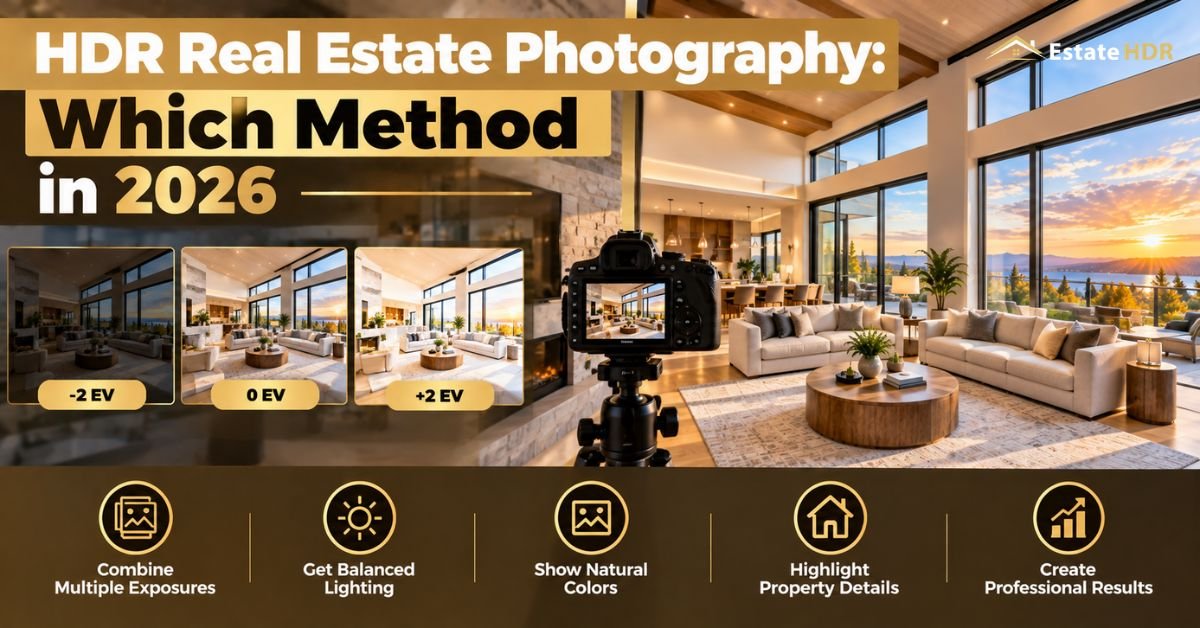
- One stop is roughly a doubling of light. Three frames spaced one stop apart cover a range of four times brighter to four times darker than the middle frame. In an ordinary room with one window, that is enough to hold the view and keep shadow detail in the far corner.
- Push the spacing to two stops and the gaps between frames get wide. The blend then has to invent the brightness values in between, which is where flat, plastic-looking results come from.
- Add frames instead of widening the gaps. Five at one stop beats three at two stops every time, even though both cover a similar range on paper.
"There is a practical limit. Every extra frame is another chance for something in the room to move. Net curtains, a ceiling fan, leaves outside the window. Seven frames of a room with a fan running produces a blend nobody can rescue. "
The Rooms That Punish a Wrong Choice
Some rooms forgive any method. Three do not.
- Bathrooms punish single exposures. Tile, mirror and two light temperatures in a small space produce colour that swings from green to orange across one frame.
- Kitchens punish brackets. Reflective surfaces catch whatever light is in the room and under-cabinet lighting sits at a different temperature from the window. A blend can balance brightness. It cannot easily separate two colours sharing one surface.
- Rooms with a view punish speed. The frame exists to sell the view. Rushing it produces a white rectangle where the selling point should be.
Get those three right and the rest of the house follows. Get them wrong and no amount of care elsewhere saves the gallery.
The Window Frame Nobody Thinks About
One detail separates a gallery that looks expensive from one that does not. It is rarely discussed. When a room is blended well, the window shows what is outside. Garden, street, trees, a view. When it is blended badly, the window is a bright rectangle with a suggestion of light in it.
Buyers read that rectangle as the house having nothing to look at. They do not conclude that the photographer missed the exposure. They conclude the property faces a wall. That is why the window frame is worth the extra bracket even on a modest listing. A kitchen window showing a garden sells the garden as well as the kitchen. The same frame blown to white sells neither.
Estate HDR treats window recovery as the first check on any interior, before colour or contrast, for exactly this reason.
Shooting the Same House in Two Seasons
- Listings come back. A house that failed to sell in February relists in May with the same photos and a new agent. Those photos now show bare trees, grey light and a dark interior. Buyers cannot name the problem. The listing simply feels stale.
- Two options. Reshoot the exteriors, which costs a visit. Or have the existing exteriors finished again with a seasonal treatment, which costs per photo. The interiors usually hold up. Rooms do not have seasons. It is the front elevation and the garden that date a gallery, which is why those two frames are the ones worth rebuilding on a relist.
Automated Merging Against Hand Blending
Automated tools merge brackets in seconds. On a simple room with one window they do an acceptable job. They fall down in three places. A window with a view worth keeping, where the software averages rather than chooses. A room with two light temperatures, where it picks one and casts the other. A hard edge against bright sky, where the halo appears.
Those three cases are most of what makes a gallery look professional. The rest of the frames were never the problem.
A Test Worth Running Once
Pick the hardest room in your next shoot. A kitchen with a window behind the sink works well.
Shoot it three ways: single exposure, three frame bracket, flash plus ambient. Have all three finished. Put them side by side at listing size on a phone. Most photographers are surprised twice. The gap between single and bracket is smaller than expected in ordinary rooms. The gap between bracket and flambient is larger than expected in the kitchen. That result decides your default for the next year.
A Simple Rule for Choosing on the Day
Standing in a room with a camera, the decision has to take two seconds. Use this.
- Look at the brightest thing in the room and the darkest thing you want to keep. If both matter to the sale, bracket. If only one matters, expose for it and move on.
- Then look at the light sources. One kind of light, one method is enough. Two or more kinds fighting each other, reach for flash.
- That is the entire decision tree. It fits on the back of a lens cap and it beats any preset.
- Photographers who adopt it usually report the same thing: fewer frames, shot faster, with better results on the rooms that actually sell the house. Estate HDR sees the effect from the other end, since those sets need fewer revision rounds.
What Agents Notice and What They Do Not
Photographers argue about method. Agents never mention it.
What agents do notice: whether the window shows the garden or a white rectangle, whether the kitchen looks clean or yellow, whether the gallery holds together. They attribute all three to the photographer rather than to the method, which is correct from where they sit. Pick the method that delivers those three in the time available. Nobody is grading the technique.
About the author
The Estate HDR Team finishes listing photography for photographers, agents and brokerage marketing staff across the United States, with more than a million photos processed for over 500 agencies. The studio was founded in 2020. Its production, retouching and quality leads are named on the studio team page. The company profile sits on the About page.
The Short Version
HDR real estate photography is a default rather than a rule. Bracket the rooms with windows worth showing, switch to flambient where colour casts fight you, shoot a single frame where the room is evenly lit and nothing is gained by three. Then let the blend be made by someone who can see the whole gallery. Estate HDR hand blends at $0.80 per photo on a 24 hour turnaround. Start with a free first order or email info@estatehdr.com.
Frequently Asked Questions
What is HDR in real estate photography?
The letters stand for a wide brightness range. In practice HDR means combining several frames shot at different exposures so the finished image holds both a bright window and a dark corner. A camera cannot record that range in one frame. The photographer shoots a bracket, usually three to seven frames, then the exposures are blended. Done well it looks like the room looked to the eye. Done badly it produces grey ceilings and glowing edges.
Is HDR or flambient better for real estate?
Neither wins everywhere. HDR blending handles rooms with heavy window light and no space for lighting gear. Flambient, which mixes flash with ambient frames, produces cleaner whites and truer colour in rooms with mixed lighting. Flambient takes longer on site. Most working photographers use HDR as the default and switch to flambient for kitchens, bathrooms and anything with strong colour casts.
How many brackets should I shoot for interiors?
Three frames at one stop apart covers an ordinary room. Five at one stop handles a bright window against a dark interior. Seven is rarely useful and doubles the alignment risk, since anything moving in the room appears twice. Shoot on a tripod with a two second delay. A bracket set that shifted between frames causes more problems than a narrower range would have.
Why do my HDR photos look fake?
Three usual causes. The blend lifted shadows too far, which flattens the room and removes depth. Ceilings came out grey instead of white, which happens when the midtones are pushed. Or a halo appeared along the window frame where two exposures met. All three are processing decisions rather than camera faults, which is why the same bracket set can produce a natural image or an obviously fake one.
Can you do HDR with one exposure?
You can lift a single raw file considerably and for an evenly lit room that is often enough. The limit is the window. A single frame exposed for the room records the window as white with nothing behind it so there is no view to recover. If the window matters to the sale, shoot the bracket. If the room has no windows worth showing, a single exposure saves time.
What is flambient photography?
Flambient blends a flash frame with an ambient frame. The flash frame provides clean, neutral colour on walls and ceilings. The ambient frame provides the natural window light and the warmth of the room. Combining them gives white whites without the lifeless look flash alone produces. It takes more frames per room and more care in the blend, which is why it costs more time rather than more money.
Do I need a tripod for HDR real estate photography?
Yes, for anything bracketed. The frames have to align precisely and handheld sequences shift between exposures no matter how steady you are. Misalignment shows up as ghosting along edges and doubled lines in blinds. A tripod also keeps the camera level, which fixes leaning verticals at the source rather than in the crop.
How much does HDR photo editing cost?
Per-image pricing is standard. Estate HDR publishes editing at $0.80 per photo as the standard rate, with volume tiers from $0.60 on the first 24 images down to $0.45 at 100 or more, on a 24 hour turnaround. Hand blending costs more than automated merging because a person is deciding where each exposure contributes. That decision is the whole product.
Should I use my camera's built-in HDR mode?
In-camera HDR produces a single merged JPEG with the decisions already baked in. It is fast and it removes your options. The merge cannot be adjusted afterwards, ceilings often come back grey and the file has less room for correction. Shoot the bracket as raw files instead. The extra storage costs nothing against the flexibility.
What is the best time of day for interior photography?
Mid morning to early afternoon on a bright, lightly overcast day. Direct sun through a window creates a brightness range that even a seven frame bracket struggles with and it throws hard shadow shapes across floors. Overcast light is softer and more even, which makes every blend easier. For twilight frames, the window is roughly twenty minutes either side of sunset.