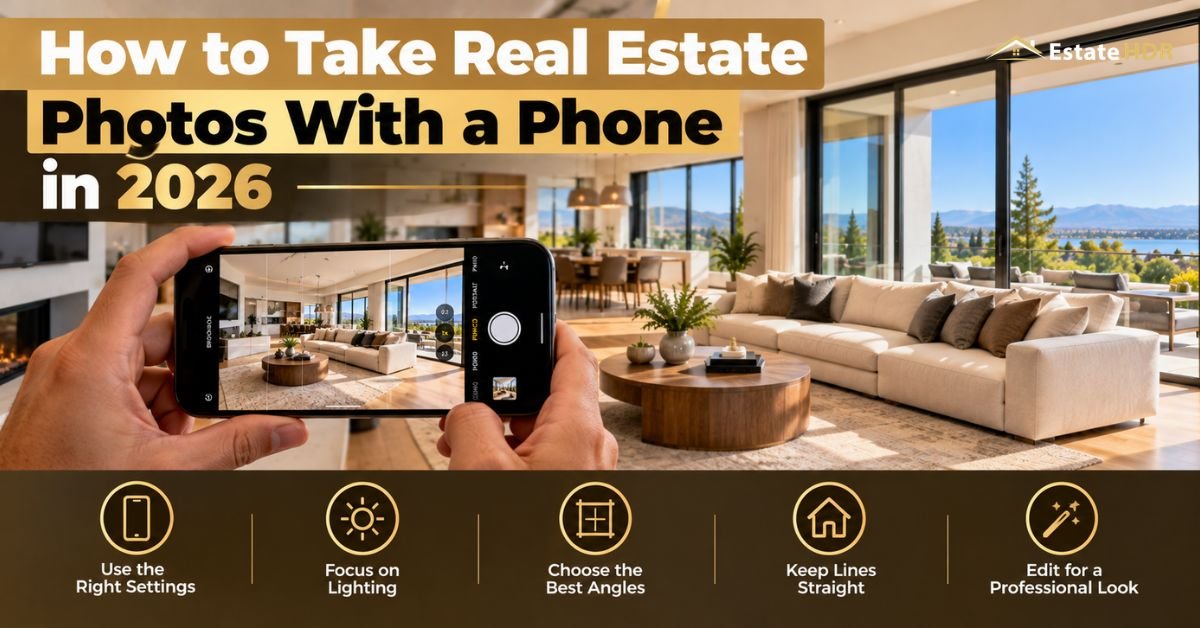
By Estate HDR Team | Published: October 2026
An agent with a listing going live on Thursday does not have a photographer. They have a phone, twenty minutes and a seller watching. That is the real situation behind most searches for how to take real estate photos and almost every guide answers it by recommending a camera.
This one assumes the phone. It also says where the phone runs out.
Quick Answer at a Glance
| Question | Short answer |
|---|---|
| Biggest single upgrade | A small tripod. It fixes leaning walls before they happen |
| Where to stand | Room corner, chest height, phone level |
| Exposure rule | Expose for the window. Lift the room later |
| What to turn off | Scene enhancement, beauty mode, anything automatic that cannot be undone |
| Photos needed | Twenty to thirty for a typical home |
| Where a phone fails | Dusk exteriors, mixed lighting, anything above the local median price |
| What editing fixes | Exposure, colour, verticals, clutter. Not a blown window or a blurred frame |
The Two Minute Room Check
Do this before the phone comes out. It costs nothing and saves more than any technique.
- Turn on every light in the room. All of them, including lamps.
- Open blinds and curtains fully.
- Clear the floor. Shoes, bags, pet bowls, charging cables.
- Clear flat surfaces down to two or three objects.
- Close toilet lids. Hide bins. Remove fridge magnets and family photos.
- Check the mirror and the television for your own reflection before shooting.
Six items, two minutes. They remove most of what an editor would otherwise charge you to remove and some of it cannot be removed at all once a reflection is in the glass.
The Five Rules That Do the Work
Keep the phone level
Leaning walls are the single clearest sign of an amateur frame. Tilt the phone up and the building falls backwards. Tilt down and the room narrows.
Most phones have a built-in level in the camera settings. Switch it on. Hold the phone upright, chest height, level. Correcting a tilt afterwards is possible. It costs cropping, which means losing part of the room you were trying to show.
Expose for the window
A phone left to decide will expose for the room and blow the window to white. That white has no data behind it. No editor can bring back a view that was never recorded.
Tap and hold on the brightest part of the window to lock exposure there. The room will look too dark on screen. That is correct. A dark room with a recorded window is recoverable. A bright room with a white window is not.
Shoot from the corner
Stand in a corner, show two walls and the floor between them. That is what reads as space.
Doorway shots at eye level flatten a room into a wall with furniture against it. Corner shots at chest height give depth. The difference is free.
Avoid the widest lens
The ultra wide setting looks like it shows more of the room. It stretches the far wall, bends straight lines near the edges and makes furniture look undersized.
Use the main lens. Step back instead of zooming out. If the room genuinely will not fit, shoot it from two corners rather than cramming it into one distorted frame.
Shoot the same room twice
Once with the lights on, once with them off, both from the same position. It costs ten seconds.
Mixed lighting is the hardest thing to fix afterwards. Having both versions gives an editor the option of blending them, which produces the lamp glow without the orange cast on the ceiling.
Exteriors and the Weather Problem
The front of the house is the frame that decides whether anyone opens the listing. It is also the one most dependent on something nobody controls. Bright overcast is the easiest condition for a phone. Harsh midday sun throws hard shadows across the front and blows the roof. Rain flattens everything.
Check which way the front of the house faces before picking a time. A north-facing front never gets direct light so waiting for golden hour achieves nothing. When the weather refuses to cooperate on a deadline, day to dusk conversion at $4.00 per photo turns a flat grey exterior into an evening frame. Shoot it anyway, then decide.
What Editing Can and Cannot Rescue
Be precise about this, because it decides what you need to get right on the day.
| Problem | Fixable | Notes |
|---|---|---|
| Room too dark | Yes | As long as the file is not pure black in the shadows |
| Colour cast from lamps | Yes | Easier when you shot the lights-off version too |
| Leaning verticals | Yes | Costs some crop |
| Lens distortion | Yes | Standard correction |
| Clutter, bins, cables | Yes | Billed per photo |
| Blown out window | Partly | Only if some data survived. White is white |
| Blurred or shaken frame | No | Nothing recovers detail that was never recorded |
| Wrong angle or bad position | No | That is a reshoot |
Finishing is where a phone set stops looking like a phone set. photo editing service runs at $0.80 per photo with volume tiers from $0.60 down to $0.45. The photo enhancement guide shows what changes frame by frame.
What It Costs to Do Nothing
Agents weigh photography against its price. The comparison that matters is against the alternative. A listing with weak photos still sells. It sells slower, with more viewings from buyers who were never serious, after at least one price conversation with the seller. None of that appears as a line item. All of it costs more than a gallery.
There is a second cost that lands on the agent rather than the seller. Sellers compare your listings with the ones they see online before they pick an agent. Your photo galleries are your portfolio whether you treat them that way or not.
Estate HDR sees this pattern from the production side. The agents who send in self-shot frames every week are usually the ones winning listings, because their galleries look consistent even when the photography was done in twenty minutes.
Why a Phone Struggles, in Plain Terms
Worth understanding once, because it explains every rule above. A camera sensor records a range of brightness. Anything brighter than the top of that range records as pure white. Anything darker than the bottom records as black. A phone sensor is small so its range is narrower than a camera's.
A living room with a sunny window often spans more brightness than the phone can hold in one frame. Something has to give. Left alone the phone sacrifices the window, because the room fills most of the picture.
That is why the exposure rule exists. Keeping the window and lifting the room afterwards works. Keeping the room and inventing the window does not, because there is nothing there to work with. Everything else follows from the same limit. Mixed lighting splits the colour as well as the brightness. Dusk pushes the whole scene to the dark end. Neither is a technique problem.
Rentals and Short Lets
Different maths applies here, which agents often miss. A sale listing lives for weeks. A short-term rental listing lives for years and earns from every booking it attracts. The same gallery works across dozens of tenancies so the cost per use falls to almost nothing.
Long lets sit in between. One tenancy, modest rent, fast turnover. Self-shot frames plus finishing is usually the right level there.
For a short let, treat the photos as an asset rather than an expense. Estate HDR finishes those sets the same way it finishes sale listings, which matters because booking platforms compress images hard and a weak frame falls apart under compression.
The Five Rooms Worth a Professional
Most listings do not need a full shoot. Some frames do.
The hero exterior, because it carries the click. The main living space, because it sets the scale for the whole house. The kitchen, because buyers study it hardest. The primary bedroom. One twilight frame if the property is above the local median.
Five frames shot properly beside twenty-five decent phone frames beats thirty average ones. If budget forces a choice, that is where it goes.
When to Hand It Over Completely
Three situations where a phone is the wrong tool regardless of technique.
Anything priced well above the local median, where buyers expect production values and notice their absence. Anything with a view worth selling, since a view against bright sky is the hardest exposure in the job. Anything with a dusk or twilight component, which a phone cannot hold.
For everything else, self-shot frames plus professional finishing is a sensible middle. Per-unit rates sit on the published pricing block and the listing photography tips cover composition in more depth.
A Twenty Minute Shooting Order
Working in a fixed order stops rooms being missed, which is the most common complaint after a self-shot gallery goes live.
Walk the whole property first with no phone in hand. Decide the order. Open blinds as you go. Shoot the front exterior. Get this while the light is what it is. Main living space, two corners. Kitchen, one corner plus one detail. Dining area, then any additional reception room. Bedrooms in size order, largest first. Bathrooms. Check the mirror for reflections before each one. Garden or outdoor space, including one frame showing the house from the garden. Rear exterior, then anything special: fireplace, view, built-in storage.
Nine steps, roughly twenty minutes in a three bedroom home. The order matters more than the speed.
Before You Upload: The Final Check
Open the whole set on a phone screen, not a laptop. That is where buyers will see it.
- Scroll the set once at normal speed. Anything that jumps out is what a buyer sees first.
- Check the first frame. It carries the click. If it is not the strongest image, reorder.
- Look for yourself in every reflective surface again. Mirrors, ovens, televisions, picture glass.
- Check verticals on the exteriors. Leaning walls are most obvious on the frame buyers open first.
- Count the rooms against the floor plan. A missing bedroom reads as something hidden.
Five minutes. It catches the errors that generate the awkward phone call from the seller on listing day.
The Part Agents Get Wrong Most Often
Clearing a room feels like work for the seller. It is actually work for the agent, because the agent is the one who has to explain a cluttered gallery later. Send the seller a list the day before. Floors clear, surfaces down to a few objects, lights to be left on, pets and their bowls out of the way. Most sellers do it willingly when asked in advance. Almost none do it well when asked at the door. Anything left behind can come out afterwards. item removal runs at $2.00 per photo, which is cheaper than a reshoot and more expensive than asking.
About the author
The Estate HDR Team finishes listing photography for photographers, agents and brokerage marketing staff across the United States, with more than a million photos processed for over 500 agencies. The studio was founded in 2020. Its production, retouching and quality leads are named on the studio team page. The company profile sits on the About page.
The Short Version
Learning how to take real estate photos on a phone comes down to five rules and a two minute check before each room. Level the phone, expose for the window, shoot from the corner, clear the floor, turn the lights on. Then let editing do the part a phone cannot. Estate HDR finishes self-shot frames at $0.80 per photo on a 24 hour turnaround. Start with a free first order or email info@estatehdr.com.
Frequently Asked Questions
Can you take real estate photos with an iPhone?
Modern phones handle a bright room competently. They struggle where listing photography is hardest: a dim interior against a bright window, a room lit by lamps and daylight at once, a dusk exterior. Phones also apply heavy automatic processing that cannot be fully switched off. For a rental, a starter home or an interim listing, phone frames are workable. For anything priced above the local median, they show.
What camera settings should I use for real estate photos?
If the phone allows it, shoot in the native raw format, lock exposure on the brightest part of the room rather than the darkest and keep the phone level. Turn off any beauty or scene enhancement mode. Most phones expose for the overall scene, which blows the window out. Locking exposure to the window and lifting the room afterwards in editing produces a far better result than the reverse.
How do you make a room look bigger in photos?
Shoot from a corner at chest height with the phone level. That shows two walls and the floor, which is what the eye reads as space. Avoid shooting from the doorway at eye level, which flattens the room. Avoid the ultra wide lens, which stretches the far wall and makes the room look distorted rather than large. Clear the floor. Visible floor reads as space.
How many photos does a listing need?
Twenty to thirty for a typical home. One hero exterior, one of every main room, one of each bathroom, one of the garden or outdoor space, one detail shot of anything special. More than thirty starts to repeat and repetition makes a listing feel padded. Fewer than fifteen leaves buyers wondering what is being hidden, which is worse than an average photo.
Should I use HDR mode on my phone for listing photos?
Phone HDR helps in a room with one bright window. It struggles with several windows or with mixed lighting, where it tends to produce grey ceilings and a flat, lifeless image. If your phone can bracket exposures manually, do that instead and have the frames blended properly. A hand-blended set from the same phone looks noticeably better than the phone's own automatic result.
Do I need a tripod for real estate photography?
A tripod is the cheapest upgrade available and the one agents skip. It keeps the phone level, which fixes leaning walls before they happen. It holds position for bracketed frames so they align. It also slows you down, which improves composition more than any gear. A small tripod with a phone clamp costs less than a single edited gallery.
What time of day is best for listing photos?
For interiors, mid morning to early afternoon on a bright, lightly overcast day. Direct sun through a window creates a contrast range no phone can hold. For exteriors, the hour before sunset gives warm light on the front of the house if the house faces the right way. Check which way the front faces before booking the time, since a north-facing front stays flat all day.
Is it worth paying a photographer for a rental listing?
For a single long let in a competitive market, self-shot frames plus professional editing usually gets you most of the way at a fraction of the cost. For a short-term rental that will be listed for years, the photography pays back across many bookings rather than one tenancy. The decision is about how long the images will work rather than the value of the property.
Can you edit phone photos to look professional?
Yes, within limits. Editing fixes exposure, colour casts, leaning verticals, lens distortion and clutter. It cannot recover a window that recorded as pure white with no data behind it and it cannot sharpen a frame that moved. That is why the capture rules matter. Give an editor a level, correctly exposed phone frame and the finished result surprises most people.
What are the most common mistakes in agent-taken listing photos?
Leaning vertical lines, a blown-out window, the photographer reflected in a mirror or a television, a toilet seat up and shooting rooms from the doorway at eye level. All five are free to fix on the day. None of them are fixable afterwards except the first two and only partly. Run a two minute check of the room before lifting the phone.