By Estate HDR Team | Published: October 2026
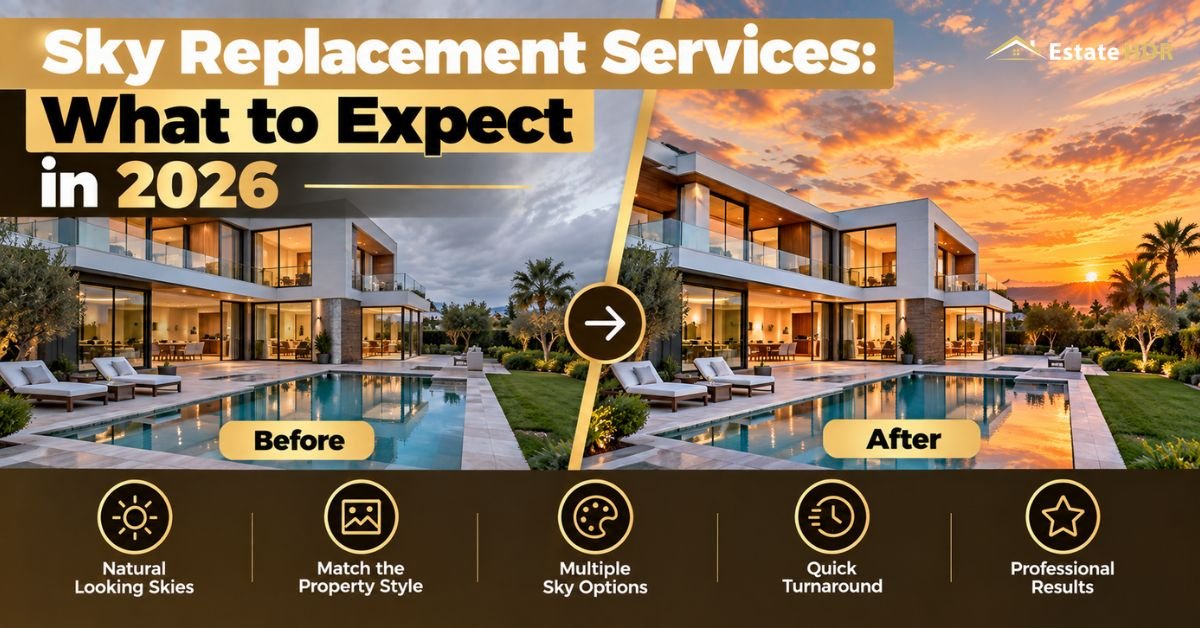
The shoot was booked for Tuesday. Tuesday is grey. The listing goes live Thursday regardless so the exterior gets shot under flat cloud and somebody fixes it later. That is the situation sky replacement services exist for. This piece is about buying them well rather than performing the edit yourself.
Quick Answer at a Glance
What You Are Actually Buying
Sky replacement sounds like one operation. It is three.
- First the mask. The sky has to be separated from everything else in the frame, including the gaps between branches and the thin lines of a railing. This is the slow part and it is where cheap work fails.
- Second the sky itself. Choosing one that matches the direction of light already on the building, at a brightness that suits the exposure.
- Third the relight. The house has to be adjusted so it belongs under the new sky. Add a warm sky without warming the building and the result looks pasted, even to someone who cannot say why.
A quote that covers only the first two is cheaper for a reason.
What Is Included and What Is Extra
This is the question that separates quotes and it is rarely answered on a price page.
At Estate HDR, sky work sits inside standard HDR and flambient editing at $0.80 per photo, with volume tiers listed on the published pricing block. The practical effect is that an exterior costs the same as an interior.
What Clean Work Looks Like
Five checks. They take thirty seconds on any sample a studio sends you.
- Zoom to where the roofline meets the sky. Look for a halo or a hard cut.
- Find a tree against the sky. Branches should survive. Cheap masking eats thin ones.
- Check the direction of light. A sunset on the left with shadows pointing left is wrong.
- Look at the windows. If the glass still reflects grey cloud, the job stopped halfway.
- Compare the roof colour to the original. A new sky usually means the roof should warm or cool slightly.
Worked examples sit in the before and after examples. The technique behind each step is covered in the sky replacement technique guide.
What to Send and What Comes Back
Ordering badly costs a day. Four lines in the order notes prevents it.
- Send the full resolution file. A compressed upload gives the mask less to work with.
- Say which frame is the hero. That sky becomes the reference for every other exterior.
- Name the time of day you want. Midday, late afternoon or evening are three different jobs.
- Flag anything that must stay. A satellite dish the seller wants removed is a separate instruction.
What comes back is the same frame at the same resolution with the sky replaced and the building adjusted to suit. If a studio returns a smaller file than you sent, ask why before the next order.
Sky Work Against Day to Dusk
These get confused constantly and the price difference is large.
Both are worth having on the same listing. One rescues the gallery. The other creates the frame that gets the click. The day to dusk conversion page lists what the evening version includes.
The Consistency Rule Nobody Enforces
Here is the failure that reaches us most often for a second opinion.
A gallery has six exterior frames. Four were shot Tuesday under cloud and had skies replaced. Two were shot Thursday in sunshine and left alone. The aerial has a third sky entirely.
Each frame looks fine on its own. Together they look like three different days, which is exactly what they are. Buyers read it as carelessness even when they cannot name the cause.
One sky per listing. One direction of light. Aerials included. Say it in the order notes rather than assuming.
Why a Grey Sky Costs More Than It Looks
Agents tolerate a flat exterior because the house is still visible. Buyers behave differently.
The front elevation is usually the first image in a listing and the one the portal uses as the thumbnail. It competes in a grid against every other listing in the area, most of which were shot on better days. A grey frame does not read as bad weather. It reads as a tired house.
There is a second effect that is easy to miss. Flat cloud removes shadow and shadow is what gives a building shape. Without it, a three dimensional house photographs as a flat shape with windows drawn on. Depth disappears along with the sunshine.
"Replacing the sky fixes the second problem as a side effect, provided the editor relights the building. The new sky implies a light direction and the house gets its shape back. That is the part a cheap swap misses. "
Estate HDR treats the relight as the point of the job rather than as an optional extra, which is why sky work sits inside the standard rate instead of being sold as an upgrade.
Choosing a Sky That Does Not Look Chosen
Most dissatisfaction with a finished frame comes down to sky selection rather than masking quality.
Three rules keep it believable. Match the brightness to the exposure already on the building, since a dark dramatic sky above a brightly lit house is a contradiction the eye catches instantly. Match the direction so the brightest part of the sky sits on the same side as the existing highlights. Match the season, because a summer sky above bare trees is a strange picture.
Beyond those three, restraint wins. The temptation is a spectacular sky with heavy cloud structure. On a modest suburban home that reads as a film poster rather than a listing.
A useful test: would a buyer standing in the driveway on a nice day see roughly this sky. If yes, it works. If the answer requires a storm front, pick something quieter.
The Frames Worth Paying Attention To
Not every exterior deserves equal care, which is useful when a deadline is tight.
- The front elevation carries the listing. It gets the most attention and the best sky. The rear elevation and garden frames matter next, since they sell the outdoor space. Side elevations, driveways and detail shots rarely need more than consistency with the others.
- Aerials sit with the front elevation in importance. They show more sky than any ground frame so a mismatch there is the most visible of all.
- If budget or time forces triage, finish the front elevation and the aerial properly, then bring everything else into line with them. That ordering produces a better gallery than spreading equal effort across every frame.
Automation and Its Limits
Automated sky tools have improved fast. On a clean roofline against open sky they do a respectable job in seconds. They struggle in predictable places. Bare winter branches. Wrought iron. Chain link fences. Anything the sky shows through in thin slivers. They also tend to leave the building untouched, which produces the pasted look. A comparison of approaches sits in sky replacement methods compared. The useful split: automation for volume and for frames where the roofline is simple, a person for the hero exterior.
Disclosure and the Line That Matters
Most markets allow a replaced sky with a disclosure line. The line costs nothing. The harder question is what else gets changed while the sky is being worked on. Removing a cloud is weather. Removing the pylon behind the house is the property. A studio that will remove anything you ask is a risk rather than a service. Ask where their limit sits before you need to know.
When Not to Replace the Sky
Three cases where leaving it alone is better.
- When the original sky is already good. Replacing a decent blue sky with a dramatic one is the tell that the gallery has been over-processed.
- When the shoot was in hard direct sun with strong shadows. The shadows fix the sun's position so a dramatic evening sky fights them.
- When only one frame in the gallery needs it. One perfect exterior beside five grey ones looks worse than six consistent grey ones.
A Buying Checklist
- Is sky work included in the per-photo rate or billed separately.
- Are complex frames such as bare trees quoted differently.
- Does the price include relighting the house to match the sky.
- How many revisions are included and what counts as one.
- Will the same sky be applied across the whole listing including aerials.
- What is the turnaround, counted from upload.
- What will you not remove from an exterior.
Seven questions, two minutes. Any studio worth using answers each in a sentence.
About the author
The Estate HDR Team finishes listing photography for photographers, agents and brokerage marketing staff across the United States, with more than a million photos processed for over 500 agencies. The studio was founded in 2020. Its production, retouching and quality leads are named on the studio team page. The company profile sits on the About page.
The Short Version
Buying sky replacement services comes down to four questions: what is included, what a complex frame costs, how many revisions you get and whether the studio relights the house or only swaps the sky. Ask those four and the quotes separate themselves. Estate HDR includes sky work in standard editing at $0.80 per photo on a 24 hour turnaround. Start with a free first order or email info@estatehdr.com.
Frequently Asked Questions
How much do sky replacement services cost?
Sky work is usually included in standard editing rather than billed separately. Estate HDR publishes editing at $0.80 per photo as the standard rate, with volume tiers from $0.60 down to $0.45 and sky replacement sits inside that. A day to dusk conversion">day to dusk conversion is a larger job at $4.00 per photo, since it changes the lighting on the whole building rather than only the area above the roofline.
How long does sky replacement take?
A straightforward exterior comes back inside the standard turnaround, which is 24 hours at Estate HDR. Complexity changes the work rather than the price. A house with bare trees, aerials and a wrought iron railing against the sky takes far longer to mask than a plain roofline. Ask whether complex frames are quoted separately before you send a set full of them.
Is sky replacement allowed on MLS listings?
Most MLS rule sets permit it with disclosure, treating the image as materially altered. The wording differs by market so check your own rules rather than copying another area's practice. The common sense test holds everywhere. Changing the weather is accepted. Changing what the property looks out onto is not, since that misrepresents the home itself.
Can you tell when a sky has been replaced?
Poor work announces itself. Edges that cut through tree branches, a sky that looks lit from a different direction than the house, colour spill missing from the roof, reflections in windows still showing the old grey. Clean work is hard to detect because the house was relit to match the new sky, which is the step cheap editing skips.
What photos work best for sky replacement?
An exterior shot with a clear separation between the roofline and the sky. Flat overcast days are the easiest to replace, since the light on the house is soft and neutral. Hard direct sun is harder, because the shadows on the building tell the viewer where the sun was and a new sky has to agree with them. Shoot the exterior anyway on a grey day.
Do you need the raw file for sky replacement?
A full resolution JPEG is usually enough for the sky itself. The raw file helps when the house also needs lifting, since the sky swap often means brightening the building to match the new light. If you have both, send both. If you only have a JPEG, say so, since the editor will work differently knowing there is no shadow data to recover.
Can sky replacement be done on drone photos?
Yes and aerials often need it more than ground frames, since a drone shoots more sky than a ground camera does. The extra care goes into matching the aerial to the rest of the gallery. An aerial with a blue sky sitting beside ground exteriors under grey cloud is worse than leaving both as shot. Treat the whole set together.
What is the difference between sky replacement and day to dusk?
Sky replacement swaps the area above the roofline and adjusts the house to suit. Day to dusk rebuilds the entire scene for evening: warm sky, lit windows, glow on the driveway, reflections in the pool. The second is a much larger job, which is why it is priced separately at $4.00 per photo against sky work included in standard editing.
How many revisions should sky replacement include?
Ask before ordering, because sky choice is subjective and a second round is common. Estate HDR includes revision rounds rather than billing them. Where revisions cost extra, a cheap first quote becomes expensive on exactly the frames where the agent has an opinion about the colour of the clouds, which is most hero exteriors.
Should every exterior photo have the same sky?
Yes, within one listing. Different skies across a gallery is the fastest way to make a set look assembled rather than shot. One sky, consistent direction of light, same time of day across every exterior frame including aerials. This sounds obvious. It is the most common consistency failure in sets that arrive for a second opinion.