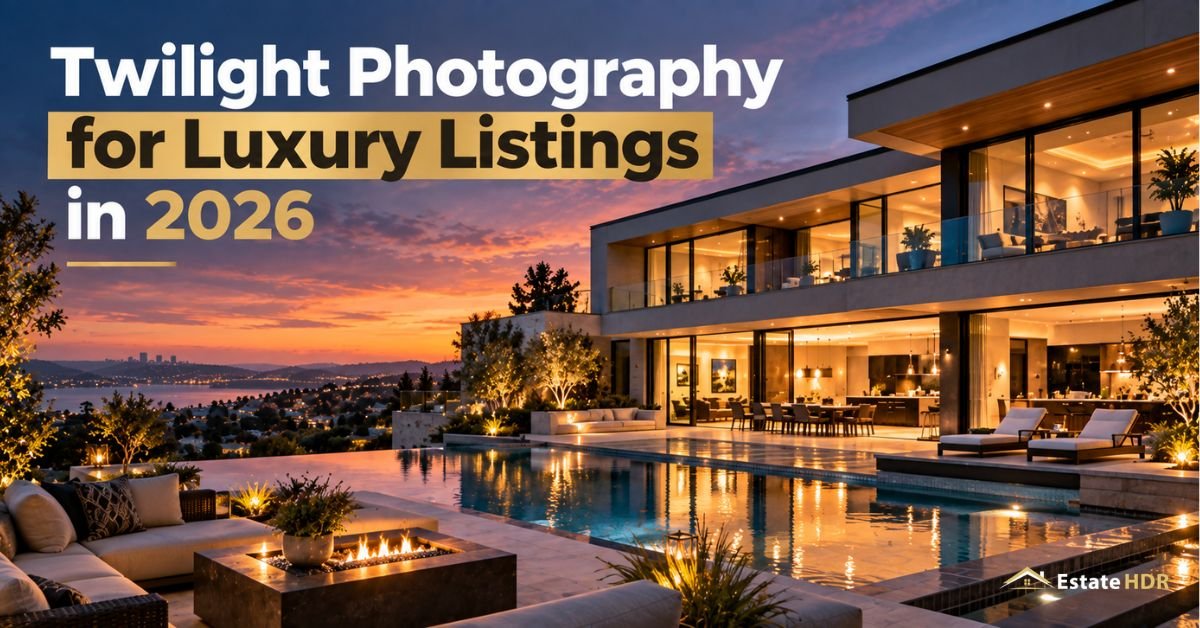
By Estate HDR Team | Published: September 2026
The sun sets at 7:42. By 8:05 the sky has gone flat gray and the shoot is over whether you got the frame or not. Twilight photography runs on a clock that doesn't negotiate. Most shooters lose the picture before they lose the light because the tripod was still moving when the sky peaked. This post lays out how to plan an evening around that narrow window: what to balance, which lights to switch on and how to bracket while the exposure keeps sliding. It also sets the quality bar an edited version has to clear before you reach for one.
Quick Answer at a Glance
Real dusk work means shooting in the 20 to 30 minutes after sunset while the sky still holds color and the windows read warm. You balance sky brightness against the interior lamps, switch on every fixture that helps the facade, then bracket fast. The scene loses roughly one stop of light every four to five minutes.
| Question | Short answer |
|---|---|
| Best window | About 20 to 30 minutes after sunset, ending when the sky goes black |
| What you balance | Sky brightness against interior lamps and landscape lights |
| Camera baseline | Tripod, RAW, f/8 to f/11, ISO 100 to 400, manual focus |
| Bracketing | Three to five frames one stop apart, reshot every few minutes |
| Most common failure | Arriving late and rushing the composition |
| Edited alternative | Virtual twilight from a daytime file, $6.00 per image |
Dusk Terms Worth Knowing
Civil twilight: the stretch between sunset and the moment the sun sits six degrees below the horizon. Across most of the US that runs 20 to 30 minutes. It stretches longer in summer and further north.
- Blue hour: the slice of civil twilight when the sky reads deep blue instead of orange. Shorter than an hour despite the name.
- Ambient to interior balance: the brightness gap between the sky and the light spilling out of the windows. Close that gap and the house glows. Miss it and you get black glass or blown white rectangles.
- Exposure ramp: how fast the scene darkens after sunset. Plan for about a stop every four to five minutes.
- Mixed color temperature: warm bulbs near 2700K sitting inside a scene lit by a sky closer to 10000K. That contrast is the whole appeal.
Twilight Photography: Balancing the Sky Against the Windows
There is one moment each evening when the sky and the windows sit at almost the same brightness. That's the frame you came for. Earlier and the sky wins while the glass looks dead. Later and the windows win while the house floats in black like a lantern.
Read the histogram instead of the screen. Screens lie in the dark. You want a sky that still separates from the roofline and window panes that hold some texture in the curtain rather than clipping to pure white. In practice the sky sits roughly one stop above the interior spill (give or take how much wattage is burning inside).
On a clear evening the crossover is usually reached about 12 to 18 minutes after sunset. Thin cloud stretches it. Heavy overcast can erase it, which is the night you pack up and rebook.
Which Lights Go On and Which Ones Hurt
Everything inside goes on. Closets, pantry, laundry, the range hood, under-cabinet strips. A single dark room on a lit facade reads as a fault. Buyers notice it without knowing why. Color matters more than count. Swap any cool 5000K bulb in a front-facing room for a 2700K warm one before you set up, because one blue window in a row of amber ones looks broken.
Path lights, uplights on trees, porch lanterns, pool and spa lights: all on. Garage floods usually come off. They are too bright and they flatten the driveway. Kill the TV. Stop the ceiling fans. Raise the blinds fully so the rooms show depth instead of a glowing slat pattern.
Virtual Twilight Service Snapshot
|
|
| Field | Detail |
|---|---|
| Service | Virtual twilight conversion from a daytime exterior |
| Accepted inputs | A wide angle daytime exterior photo, RAW or high resolution JPG |
| Delivered formats | Full resolution JPG for print plus a web sized MLS file, sRGB |
| Turnaround | 12 to 24 hours |
| Starting price | $6.00 per image |
| Client rating | 4.99 out of 5 from 210+ reviews |
Sky options, window illumination and landscape lighting details sit on the virtual twilight service page.
Three Routes to a Dusk Exterior, Side by Side
A shoot, a golden hour conversion and a blue hour conversion all end with a warm house on a colored sky. What separates them is risk, time and price.
| Factor | Real dusk shoot | Day to dusk edit | Virtual twilight edit |
|---|---|---|---|
| Usable window | 20 to 30 minutes after sunset | Any daylight hour | Any daylight hour |
| Extra time on site | 60 to 90 minutes | None | None |
| Frames needed | 3 to 5 brackets per angle across 2 to 4 angles | One daytime frame | One daytime frame |
| Sky delivered | Whatever that evening gives you | Golden hour and amber sunset | Deep indigo, starry midnight blue, crimson sunset |
| Price per image | Your own session rate | $4.00 | $6.00 |
| Turnaround after capture | Your own edit time | 12 to 24 hours | 12 to 24 hours |
| Weather risk | High | None | None |
Golden hour conversions and their reflection work are covered on the day to dusk page.
The Twenty Minute Window Problem
Here is the part nobody writes down. Every article tells you the window is short. Almost none of them publish the actual evening schedule. Photographers show up an hour early, stand around and still miss the peak because the hero angle was being composed while the sky was doing its best work. You have probably watched an evening slip away exactly like that.
- Treat sunset as zero and count outward. This order has one job: put your best angle inside the ten minutes that matter.
- T minus 75: arrive, walk the lot, choose two hero angles and one detail angle. Note where the sun is dropping relative to the front elevation.
- T minus 60: walk the house with the seller. Bulbs swapped, blinds up, cars moved, hoses coiled, bins hidden, pool cover off.
- T minus 45: shoot the full daytime exterior set. This is your insurance file and your conversion source if the evening falls apart.
- T minus 30: tripod on the hero angle, composition locked, manual focus set on the front door and left alone.
- T minus 10: every light on. Walk the property once looking for a dark window.
- T minus 5 to T plus 12: hero angle brackets, a fresh set every three minutes.
- T plus 12 to T plus 22: second angle. This is the peak of the blue hour. Nothing else gets priority here.
- T plus 22 to T plus 30: rear elevation or pool, where interior spill matters more than sky color.
- T plus 30: stop. The sky is black now. Anything later is a night photo, not a dusk one.
Sunset time moves about a minute a day. Check it for the exact date, not the week.
Shooting the Hero Frame Step by Step
- Lock the camera down. Tripod at about chest height, leveled, remote release or a two second timer, electronic shutter if you have it. Focus manually on the front door and stop touching the ring.
- Set a base exposure at f/9 and ISO 100, then let the shutter go as long as the sky asks. Shoot RAW. Auto white balance is fine at capture since you will set it properly later.
- Bracket three to five frames one stop apart rather than two. Dusk holds less contrast than a midday exterior. Wide brackets burn minutes you do not have.
- Re-meter and shoot the whole set again every three minutes. Your fifth set will almost always beat your first, because the balance keeps improving until it suddenly does not.
- Add one darker frame exposed for the windows alone. It becomes your blending layer when a pane clips. Cost: eight seconds.
How Estate HDR Handles a Twilight File
- Submit: upload the daytime exterior or your evening brackets through the client dashboard and pick a sky. Deep indigo, starry midnight blue or crimson sunset horizon.
- Produce and QA: editors blend the frames, activate window and landscape lighting where it belongs, rebuild ground shadows for the new light direction and clear daytime distractions. Every file passes a three tier quality check.
- Delivery: finished images come back inside 12 to 24 hours with revisions included until the sky and the glow look right.
Recent dusk work sits in the Estate HDR portfolio. The first order is free when you open an account.
What Real Light Gives You That an Edit Cannot, Plus the Reverse
Real light behaves. A porch lantern throws a bright pool on the brick right below it and fades out three feet away. Uplights wash a stone column and push shadows upward. Pool water lit from inside ripples. That ripple moves during a four second exposure. Sky color appears in the window glass at the same hue as the sky above the roof, because it is the same sky. Wet pavement holds all of it. An editor rebuilds those cues by hand and gets close. The physics still happened on site.
Now the reverse, which almost nobody admits. A conversion delivers a clean evening sky on a week of solid rain. It gives twelve listings the same look for a brokerage that wants a consistent feed. It works in December when sunset lands at 4:50 p.m. and the sellers are still at work. It costs no second trip, no overtime and no gate code after dark. When a price cut calls for fresh photos in March, you re-edit instead of rebooking. One caution. MLS rules and the FTC both care about images that mislead. A replaced sky is normally fine. Adding landscape lighting the property does not own is not.
What Each Route Costs
A real evening shoot is priced by your own time. The honest math includes the second trip, the hour of light and the blending afterward. Some photographers fold it into a luxury package. Others bill it as an evening add-on.
"An edit is priced per image instead. Blue hour conversions start at $6.00 and golden hour conversions start at $4.00, both back in 12 to 24 hours. Current rates for every service sit on the pricing block and questions go to the contact page."
Think about an agent listing a hillside property with a wraparound deck and a lit pool. The evening shoot is booked for Thursday. Thursday brings rain. The open house is Saturday. She already has a full daytime set from the same trip. Friday morning she sends the best front elevation and the pool angle for conversion. Both files land Friday night with indigo skies and warm glass. The real shoot gets rebooked for the following week and replaces them once the weather clears. Nothing sat dark on the portal.
About the author
Written by the Estate HDR editing team. The group has finished more than one million property photos for over 500 agencies, including blue hour conversions and blended evening brackets across every US market. Questions and file samples are welcome any time. Estate HDR was founded in 2020 and its production, retouching and quality leads are named on the studio team page. The studio profile sits on the About Estate HDR page.
Bring the Evening Look to Every Listing
Twilight photography is worth learning properly, because the standard it sets is the standard an edit has to match. Shoot the real thing when the calendar and the weather allow it. Convert when they don't. Estate HDR handles the second path from $6.00 per image with unlimited revisions and a free first order. The team answers at info@estatehdr.com. For the marketing case behind the look, read why virtual twilight works for luxury homes. You can also compare it against a golden hour conversion before you pick one.
Frequently Asked Questions
How do I find the exact sunset and civil twilight times for a shoot date?
Use a sun position app or the US Naval Observatory tables. Enter the property address rather than the city center. Elevation and terrain shift the practical horizon by several minutes. A house behind a west facing ridge loses direct sun early while the sky above it stays bright, which actually widens your working period. Check the figure the day before too. Sunset moves roughly a minute per day and a week old number will already be off.
Do I need off-camera flash for a dusk exterior?
Not usually. Long exposures on a tripod collect plenty of light from the house itself. Flash earns its place in two spots. One is an entryway with a deep covered porch where the ceiling goes muddy. The other is a front door surround you want readable in the final crop. One bare speedlight fired into the porch ceiling on a single frame is enough. Blend that frame in later. Firing flash across the whole facade tends to flatten the depth you just spent an hour building.
Is full frame gear required or will a crop sensor work?
A crop sensor works. Everything sits on a tripod at base ISO with the shutter open for seconds. The sensor size advantage in low light barely shows up. What matters more is a lens wide enough to hold the whole elevation without stepping into the street. On crop bodies that usually means something around 10mm to 18mm. A cheap tripod hurts your files far more than a smaller sensor ever will.
How many evening images does one listing actually need?
Two to four. The front elevation is required. A rear or pool angle is worth having when the backyard is a selling point. Beyond that the returns drop fast, because portals show a thumbnail grid and a run of dark frames makes the set look repetitive. Lead with the front elevation, place a second dusk frame near the middle of the gallery and keep the rest of the set in daylight so buyers can read the property clearly.
Does an evening exterior work for condos and townhomes?
Sometimes. A ground floor unit with a private patio or a townhome with its own front door and porch light can carry it. A single window on the eleventh floor of a tower cannot, because there is no facade to light. For high rise units the better evening shot is usually the view out of the window or a shared amenity deck at dusk. Point the camera at what the buyer is actually purchasing.
What white balance setting works best after sunset?
Shoot RAW and set it in post. As a starting point, somewhere between 4000K and 5000K keeps the sky believable while leaving the windows warm. Pushing cooler makes the sky more saturated at the cost of orange interiors that look like fire. Pushing warmer neutralizes the bulbs and the blue drains away. Many editors split the difference by masking the sky and the windows separately, then balancing each one on its own.
Can I fly a drone at dusk for aerial evening shots?
Yes, with conditions. FAA Part 107 permits night operations for certified remote pilots when the aircraft carries anti-collision lighting visible for three statute miles and the pilot has completed the current recurrent training. Check airspace authorization for the address first. Practically speaking, aerials hold up better slightly earlier in the window than ground shots, because the sky occupies more of the frame and it needs to still be showing color.
Do I have to disclose that a sky was replaced?
Rules vary by MLS. Read your local handbook before uploading. Most boards treat sky replacement as an accepted enhancement while treating anything that changes a property feature as misrepresentation. NAR guidance and FTC advertising standards both point the same direction. A safe habit is a short line in the listing remarks noting that exterior images were digitally enhanced. It costs nothing and it removes the argument entirely.
What can I do if the property has no landscape lighting at all?
Work with what exists. Interior spill through large windows carries a facade on its own. A single porch fixture plus a lit garage interior with the door open adds depth. Renting two portable uplights for an evening is a small expense on a luxury listing. If you request a digital version instead, ask the editor to light only fixtures that are physically present in the frame. Inventing lights the buyer will never find is where trouble starts.
What file and resolution should I send for a conversion?
Send the highest resolution version you have, straight from the camera where possible. A wide angle exterior shot on an overcast day or in flat afternoon light converts best, because harsh midday shadows have to be removed before a new sky can sit correctly. Keep the whole roofline inside the frame with a little sky above it. Files with a heavy filter already applied are harder to work with. Send the clean original.
SEO & Content Manager
✓ Verified AuthorSEO & Content Manager is a digital content strategist and architectural media researcher at Estate HDR, covering real estate photography workflows, property marketing trends, and MLS editing standards.
Ready to Elevate Your Real Estate Listings?
Experience 24-hour turnaround HDR editing, virtual staging, and day-to-dusk conversions with zero risk.