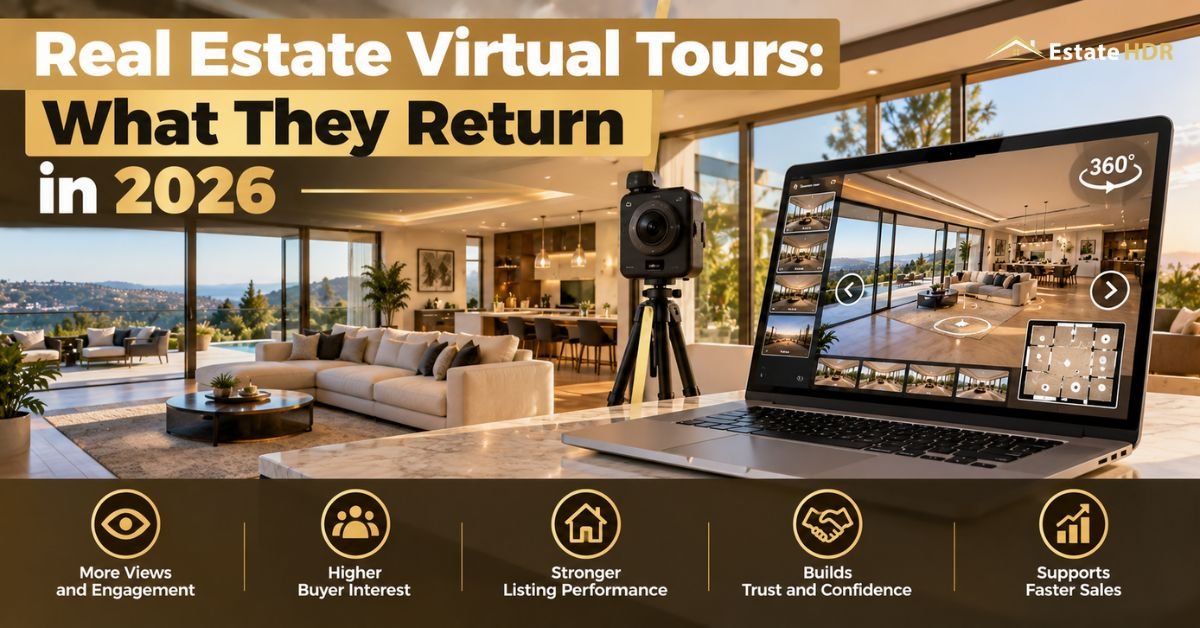
By Estate HDR Team | Published: October 2026
A seller asks why their listing sat for six weeks. The agent points at the market. Somewhere in that conversation real estate virtual tours come up as the thing that was missing. Maybe. The honest answer is that a tour changes some listings a great deal while doing almost nothing for others. The difference is predictable before you spend a dollar. This piece sorts the two apart.
Quick Answer at a Glance
| Question | Short answer |
|---|---|
| What it is | An interactive walkthrough the buyer controls, built from 360 captures or a 3D scan |
| Who gains most | Vacant homes, relocation buyers, large floor areas, anything above the local median price |
| Who gains least | Small units with simple layouts in a fast local market |
| Main return | Fewer wasted showings plus stronger listing presentations. Raw view counts matter less |
| What decides use | The still photos. A buyer who dislikes the thumbnails never opens the tour |
| Running cost | Capture fee plus monthly hosting that continues after the sale closes |
| Pairs with | A floor plan. Tours show rooms. Plans show how rooms connect |
What the Tour Is Actually Being Paid to Do
Start with the job rather than the technology. A tour is hired to answer one buyer question: does this place work for me. Not is it pretty. Whether the second bedroom fits a desk. Whether the kitchen opens onto the living room. Whether the stairs are the kind their mother can handle.
"Still photos cannot answer that. They show rooms one at a time with no sense of the distance between them. Here is the thing. A buyer who cannot build a map in their head either books a showing to find out or scrolls past. One of those outcomes costs you a Saturday. "
The tour's real work is replacing that question with an answer before anyone gets in a car. Judge it on that. A tour that looks beautiful while leaving the buyer unsure how the rooms join up has failed at the only task it was given.
The Numbers Everyone Quotes Need Care
Search this topic and you meet the same claims. Listings sell faster. Engagement multiplies. The percentages are specific. They get repeated until they sound like census data.
Almost all of them come from companies selling tour software or tour capture. The comparison is usually between listings that had a tour and listings that did not, which is not a fair fight. The seller who pays for a tour also tends to pay for better photos. That seller prices the home sensibly. That seller keeps it tidy for showings. The tour gets credit for the whole package.
There is a second problem. The listings that get tours are not randomly chosen. Agents put tours on the homes they expect to work hardest for: the expensive ones, the vacant ones, the ones with a story. Those listings would outperform the average anyway.
"None of this means tours do not work. It means the published figure is not the number for your listing. Your own last twenty listings are better evidence than any vendor chart. You already own that data. "
Where the Return Actually Shows Up
Listings won, before anything is sold
The clearest return arrives at the kitchen table during the listing presentation. An agent who opens a laptop and walks a seller through a tour of a home they already sold is making an argument the competing agent cannot match with a folder of prints. Sellers notice. That win is worth more than the tour fee on a single transaction. This return is rarely measured because it happens before the listing exists. It never shows up in a days-on-market report. Ask any agent who has used a tour in a pitch and they will tell you it is the strongest reason they keep paying for them.
Showings that filter themselves
The second return is quieter. Buyers who would have walked in and walked straight back out now rule themselves out at home. Showing counts drop. Offer counts hold. That ratio is the one worth tracking.
Sellers sometimes read fewer showings as a bad sign. Say this plainly up front. Ten showings and two offers beats thirty showings and two offers for everyone involved, the seller most of all. Thirty showings means twenty-eight evenings of tidying for nothing.
Distance and relocation
For an out-of-state buyer the tour is not a convenience. It is the only viewing they get before booking a flight. Corporate relocation, military moves, second homes, estate sales handled by family in another state. In those segments a tour is not a differentiator at all. Its absence is a disqualifier.
If your market has a steady relocation stream, the question stops being whether to produce tours. It becomes which listings can skip one.
The Photo Set Decides Whether the Tour Gets Opened
Here is the part the tour vendors skip. It matters more than the platform you pick.
Nobody lands on a tour. They land on a thumbnail. The portal shows a grid of listings with one image each. That single image decides whether the second click ever happens. If the hero shot has a blown-out window or a grey ceiling or a crooked vertical, the buyer scrolls. The tour is still sitting there, paid for, unopened.
So the capture order matters. Photos first, properly finished, then the tour. A set that has been through proper exposure blending carries the click. The tour converts it. Reverse the priority and you have bought a second-click asset with no first click.
The cost comparison is not close either. Estate HDR publishes HDR and flambient editing at $0.80 per photo as the standard rate, with volume tiers running from $0.60 per photo on the first twenty-four images down to $0.45 at a hundred or more. Set that against a tour capture fee for the same property. The editing is rounding. It is also the half that decides whether the rest gets seen.
Look at a before and after slider on the same frame and the gap is obvious inside two seconds. That is roughly how long a buyer gives a thumbnail.
Property Types Where a Tour Earns Its Fee
Not every listing needs one. The pattern is consistent enough to write down.
| Property | Tour value | Why |
|---|---|---|
| Vacant home | High | Nothing in the photos gives scale. A tour restores it |
| Above local median price | High | Smaller buyer pool, often further away |
| Large or unusual layout | High | Split levels, additions and odd flow are hard to photograph |
| New construction | High | Sells before it is finished. The tour becomes the model home |
| Small, simple, fast market | Low | Buyers view in person within days. The tour adds little |
| Tenant occupied | Low | Access and clutter usually defeat the capture |
Run that table against your own pipeline before quoting a seller. Two rows will cover most of what you list in a year.
What a Tour Costs to Keep, Not Just to Make
Capture pricing varies by market and by provider. The part that surprises people is the second line on the invoice.
Most tour platforms bill monthly per active tour. The listing sells. The hosting bill continues. Agents who ran a hundred listings over three years are often paying to host tours of homes that other families now live in. The charge is small enough per tour that nobody notices it. Multiply it by a hundred and by thirty-six months.
Decide the retirement rule before you start. Something like this: tours come down ninety days after closing, with a screen recording kept for the portfolio. Put it in writing where your admin can see it. Nobody does this. The bill grows quietly for years.
"Budget the recurring line the way you budget a lockbox subscription. It is an operating cost, not a one-off purchase. "
Tours Expire. Your Listing Archive Should Not
Related. Also worse. A tour lives on someone else's domain. When the subscription lapses or the vendor changes its plans, the link dies. Your MLS record keeps the dead link. Your blog post about that listing keeps it. Your own portfolio page keeps it. A buyer clicking a two-year-old link lands on an error page with your name near it.
Three habits fix this cheaply. Keep a screen recording of every tour you publish. Keep the floor plan file, which is a flat image that outlives any platform. Audit tour links once a year and strip the dead ones.
Floor plans are the durable layer here. They are drawn from sketches, blueprints or a Matterport scan at $12.00 per plan and delivered as print PDF, vector SVG plus high resolution image files. The 2D and 3D floor plan service page lists the accepted inputs. A plan you own sits in your own files forever. A tour you rent does not.
Tour, Floor Plan or Walkthrough Video
These three get treated as alternatives. They answer different questions.
| Asset | Buyer question it answers | Buyer controls pace |
|---|---|---|
| 360 or 3D tour | What does it feel like to stand in this room | Yes |
| Floor plan | How do the rooms connect and what are the dimensions | Not applicable |
| Walkthrough video | What story does this home tell | No |
The pairing that performs is a tour plus a plan. One gives presence. The other gives the map. A longer comparison sits in the post on virtual walkthroughs versus floor plans. The format breakdown lives in the guide to tour formats.
Video is the one most often bought by mistake. It looks impressive in a pitch. It gives the buyer no control at all, which is the exact thing a tour is for.
What Sellers Ask When You Propose One
Three objections come up again and again. Have the answers ready before the listing appointment rather than inventing them at the table. Will strangers case my house. This is the real worry behind most hesitation. It deserves a straight answer. A tour shows layout. It does not show your valuables unless you leave them in frame, which is why the pre-shoot declutter matters twice over. Personal photographs, mail, medication and anything with a serial number come off the surfaces before capture.
Does it replace open houses. No. It changes who turns up. Agents who run both usually report a smaller crowd with a higher share of people who already know the floor plan and came with a question. What happens to it after we sell. Tell them the retirement date up front. Sellers rarely think to ask. The ones who later see a tour of their old home still live on someone's website do ask, loudly.
"A short, honest answer to each of these sells the tour better than any statistic. Estate HDR hears the same three questions relayed by the photographers whose files land in the queue. "
Five Checks Before You Publish a Tour
- Open the listing on a phone. Most buyers will. If the tour takes two taps to find, move it up.
- Check the entry point. The tour should open in the main living space, never in a hallway or a bathroom.
- Confirm the still photos are finished and uploaded first. The thumbnail carries the click.
- Add the floor plan to the same gallery. The plan answers what the tour cannot.
- Record the tour link, the platform and the retirement date in your listing sheet on day one.
Measuring It Without a Dashboard
You do not need analytics software. You need four columns in a spreadsheet: listing, tour yes or no, showings per offer, days on market. Twenty rows is enough to see a pattern. Thirty is better. If showings per offer fall on tour listings, the tour is doing its job and you now have a number for your next listing presentation. If nothing moves, the money belongs in photography and staging instead.
Actually, run the same four columns on vacant versus occupied homes while you are there. That split usually explains more than the tour column does, which is useful to know before you blame the tour either way.
One warning on view counts. Platforms report tour opens. The number always looks healthy. Opens measure curiosity. Showings per offer measures whether the tour did any filtering. Only the second one is tied to money.
About the author
The Estate HDR Team finishes listing photography for photographers, agents and brokerage marketing staff across the United States, with more than a million photos processed for over 500 agencies. The studio was founded in 2020. Its production, retouching and quality leads are named on the studio team page. The company profile sits on the About page.
The Short Version
Real estate virtual tours pay off where distance or emptiness or an awkward layout makes a still photo set insufficient. They pay off less in small, simple homes that sell quickly in person. Whatever you decide, the photos come first, because they are what gets clicked. Estate HDR edits the set, draws the plan and turns both around in 24 hours. Start with a free first order or email info@estatehdr.com. Current per-unit rates sit on the published pricing block.
Frequently Asked Questions
Do virtual tours help sell houses?
They help in specific conditions rather than across the board. Vacant homes, higher priced listings, unusual layouts and buyers moving from out of the area all benefit clearly. A small apartment in a fast local market sees much less difference. The tour rarely creates a buyer who was not already interested. What it does is let an interested buyer rule the home in or out sooner, which shortens the path to an offer.
Are virtual tours worth it for real estate agents?
For most working agents the answer is yes, though not for the reason usually given. The strongest payback is winning the listing in the first place. A seller choosing between two agents remembers the one who showed them an interactive tour of a home they had already sold. Treat the tour as a sales tool for your own business and the fee justifies itself before the property is even marketed.
How much does a Matterport virtual tour cost?
Pricing depends on the plan, the property size and whether you capture it yourself or hire a provider. There is a one-off capture cost plus a recurring hosting cost per active tour. Check current rates directly with the platform, since plans are revised regularly. The recurring line is the one to model carefully. It continues after the listing closes unless you retire the tour deliberately.
How much should I charge clients for a virtual tour?
Price it against the time it takes you rather than against what a competitor charges. Count travel, capture, processing, upload and the monthly hosting you carry until the tour comes down. Many photographers underprice because they forget the last item. Bundling the tour with the photo set and a floor plan usually sells better than listing it separately. It also protects your margin on the capture visit.
What is the best virtual tour platform for real estate?
There is no single best one. Match the platform to how you work. Solo agents shooting occasionally want a low monthly commitment with simple publishing. Teams running volume want bulk management and MLS integration. Test two on real listings before committing. Check how easy it is to export or archive a tour if you ever leave the platform, because that decides what you keep.
Has anyone actually bought a house after only a virtual tour?
Yes, though it stays uncommon outside particular situations. Relocation buyers, overseas purchasers and investors do close without an in-person visit, often with a trusted local agent walking the property on video first. For most residential buyers the tour shortens the shortlist rather than replacing the visit. Expect it to reduce the number of homes someone walks through rather than the decision to walk through any.
What are the benefits of a virtual tour for sellers?
Fewer strangers walking through the house. That is the benefit sellers care about most and it rarely gets mentioned in marketing material. A tour filters out buyers who were never going to make an offer, which means less tidying, fewer evenings out of the house and less disruption for anyone living there during the listing period. Mention it when you present the idea.
How much does it cost to get a 3D tour of a house?
Local capture providers price by square footage or by a flat rate per property. The figure varies widely between markets. Ask what the quote includes before comparing two of them. Some include hosting for a set period. Some bill it separately from day one. Some include a floor plan generated from the same scan, which changes the value of the quote considerably.
Do virtual tours work for rentals?
They work well, for a different reason than on sales listings. Rental applicants are usually moving on a deadline and often from another city. A tour lets them apply without a viewing, which speeds up the let. Landlords with several units also reuse one tour across repeat vacancies in the same floor plan, which spreads the capture cost across several tenancies.
What is the difference between a virtual tour and a virtual showing?
A virtual tour is recorded and always available. The buyer explores it alone at any hour. A virtual showing is live, with an agent walking the property on a video call while the buyer asks questions and directs where to point the camera. The tour does the filtering. The showing replaces the in-person visit. Plenty of transactions now use both at different stages.