By Estate HDR Team | Published: Oct 2026
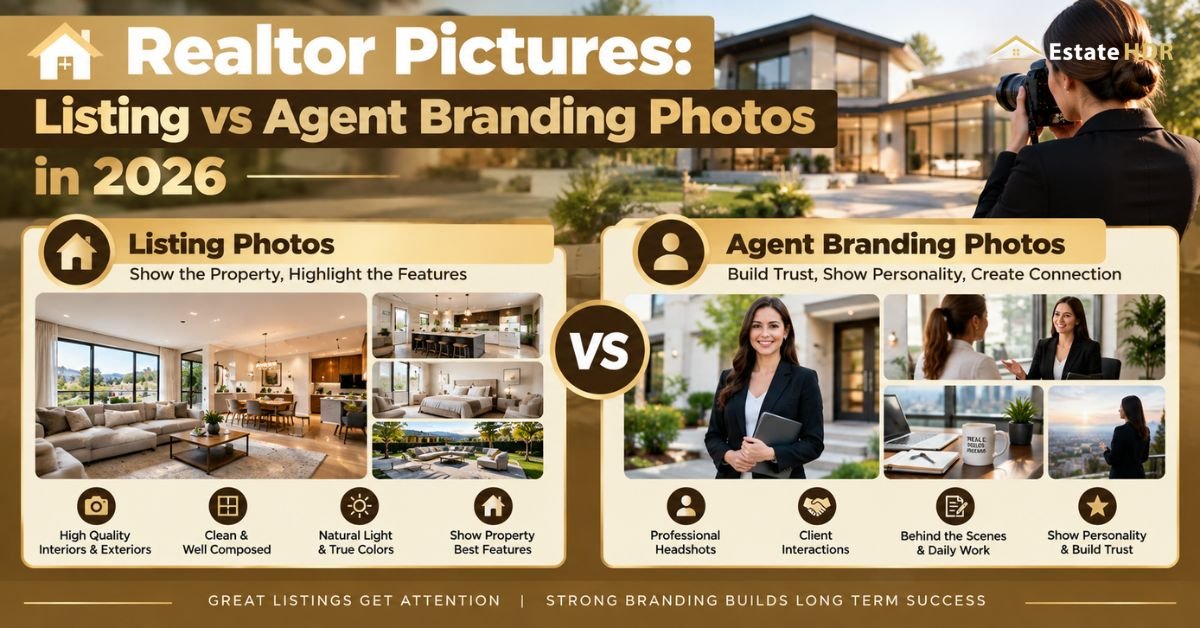
Type realtor pictures into a search bar and you get three different jobs mashed into one phrase. Some people want photos of a house for sale. Some want the agent's own face for a sign rider and a profile page. A third group wants to know which images they may reuse once a deal closes. Not the same product. Different lighting, different budgets and a very different shelf life. Mixing them up is how an agent ends up with a gorgeous portrait beside a phone snapshot of the kitchen. Here is what each one costs, how long it lasts and who owns it.
Quick Answer at a Glance
Listing photos sell one property and go stale the day it closes. Branding photos sell the agent and stay in service for a year or two across every portal, sign and social profile. One is bought per property. The other is bought per person. Copyright sits with whoever pressed the shutter unless a written license says something else.
| Question | Listing photos | Agent branding photos |
|---|---|---|
| What it sells | The house | The person |
| Who pays | Seller or listing agent, per property | The agent, once every year or two |
| Working lifespan | Days to a few months | 12 to 24 months |
| Where it lives | MLS, portals, brochures, ads | Profile pages, signs, social, email |
| Biggest failure | Dark rooms and visible clutter | A face nobody recognizes at the door |
Realtor Pictures: Four Meanings, four Different Products
- Listing photos: pictures of a property for sale, shot against a room list and delivered in a size the MLS will accept.
- Branding photos: pictures of the agent, running from a plain headshot up to a working set of lifestyle frames for a personal brand.
- Image license: the written permission that says where you may use a photo, for how long and for what purpose.
- Work for hire: a narrow legal arrangement where the buyer of the shoot owns the copyright from the first click. It only counts if it is in writing.
Keep those four straight and most of the confusion disappears.
What a Listing Set Has to Do
A listing set has one job. Stop a stranger who is scrolling on a phone during lunch. That means the photos have to read at thumbnail size first and at full screen second. Bright rooms. Straight walls. Nothing on the counter.
Coverage matters more than artistry here. Buyers expect the front elevation, the kitchen, the primary bedroom, the primary bath, the living space, the yard and anything unusual. Twenty five to forty frames covers a normal single family home. Missing rooms read as hidden problems.
There is a technical floor underneath all of that. Windows blow out unless the shooter brackets the exposure and blends the frames later. Vertical lines lean unless the camera stays level. Bins, cords, parked cars and framed family photos have to go before upload, since most MLS rules push back on identifying details. Editing handles what the shoot could not, which is why item removal and decluttering sits so close to the core of listing work.
Timing gets forgotten. Photos are normally shot two or three days before launch, which leaves no room for a reshoot.
What an Agent Branding Set Has to Do
Branding photos work in the opposite direction. Nobody is buying the wall behind you. A visitor is deciding, in about a tenth of a second, whether you look like someone who returns calls.
A plain headshot is the floor. Solid colors beat busy patterns because a loud print drags attention off the face. Turn your body about fifteen degrees off the lens and let your shoulders drop. Most sessions run sixty to ninety minutes and produce three to five usable finals. That sounds thin until you remember one face has to work everywhere.
A full branding set goes past the face. Working frames of you at an open house or handing over keys give your content calendar something to run on for months. Backgrounds should match your market too. A downtown loft specialist and a rural land specialist should not be standing against the same beige wall.
Retouching is where people slip. Soften a stray hair. Do not rebuild the jaw. AI portraits are cheap and improving, though a face that never existed makes a strange opening move for a business built on trust.
HDR Photo Editing Service Snapshot
| Field | Detail |
|---|---|
| Service | HDR and flambient photo editing">flambient photo editing for listing sets |
| Accepted inputs | CR2, CR3, ARW, NEF, DNG, RAF, RW2, JPG, TIFF. 3 to 7 brackets at -2, 0, +2 EV |
| Delivered formats | Full resolution print JPG plus a web optimized MLS JPG. sRGB or Adobe RGB (1998) on request |
| Turnaround | 12 to 24 hours standard, 12 hour rush |
| Starting price | $0.80 per photo |
| Client rating | 4.99 out of 5 from 340+ reviews |
Full technical spec and sample sets sit on the HDR photo editing service page.
The Numeric Split Between the Two Budgets
Once you stop treating both as one line item, the money starts making sense. A listing set is a small cost repeated constantly. A branding set is a bigger cost repeated rarely.
|
|
| Line item | Listing set (one property) | Branding set (one agent) |
|---|---|---|
| Frames delivered | 25 to 40 | 3 to 5 finals from a 60 to 90 minute session |
| Editing spend | $0.80 per photo | Portrait retouching, priced per image |
| Common add-on | Item removal at $2.00 per image | A second wardrobe change |
| Editing turnaround | 12 to 24 hours | Days. Nothing launches on Friday |
| How often you buy it | Every listing | Every 12 to 24 months |
Volume tiers for repeat listing work are shown on the Estate HDR pricing block.
Who Owns the Photos After Closing
United States copyright is blunt about this. The person who pressed the shutter owns the image the second it exists. Paying for a shoot buys a license to use the photos. It does not buy the copyright.
What that license actually says is the part almost nobody reads. A narrow one covers marketing that single property until it closes. A wide one covers your own promotion forever. The gap between those two shows up the day you want a sold kitchen on a postcard.
"Three situations catch agents out. First, uploading to the MLS normally grants a broad sub-license that lets portals such as Zillow and Redfin display the set, which is why old images keep surfacing on sites you never touched. Second, a listing that expires and moves to a different agent does not carry your license with it. Third, when you leave a brokerage, photos the brokerage paid for usually stay behind. Team accounts have the same trap. "
One sentence fixes most of it. Ask the photographer, in writing and before the shoot, for unlimited use in your own marketing with copyright staying on their side. That protects you and still lets them chase a competitor who lifts the file. NAR publishes association material on MLS photo copyright if you want the longer version.
Five Steps to Sort Your Picture Library
- Split everything into two folders today. One holds property sets by address. The other holds you.
- Drop a text file of the license terms beside each property folder. Two lines will do: who shot it and what you may use it for.
- Rename every branding file with the year it was taken. Old portraits hide in shared drives and reappear on a flyer years later.
- Pick one portrait and push it everywhere at once. Brokerage profile, portals, signage, email signature, every social account.
- Book the reshoot before you need it. Put a reminder eighteen months from your last session and treat it like a license renewal.
How Estate HDR Turns Brackets Into a Listing Set
- Submit: upload brackets or single frames straight from the card in CR2, CR3, ARW, NEF, DNG, RAF, RW2, JPG or TIFF. Add a short note for anything unusual in the property.
- Produce and QA: manual exposure blending, flambient layers, window masking with a landscape pull, color correction and lens fixes. A second editor checks verticals before anything ships.
- Delivery: a full resolution print JPG plus a web optimized MLS JPG in 12 to 24 hours, with a 12 hour rush lane and unlimited revisions.
Thirty seven before and after sets across eight categories sit in the Estate HDR portfolio. Push a first batch through free at the free first order page.
How Long a Headshot Lasts and Why a Stale One Costs You
Portraits age faster than agents expect. The usual advice in real estate is a refresh every one to two years. Change your hair, your glasses or your weight and that clock resets early.
The damage from an old headshot is not vanity. It is recognition. A seller who studied your photo all week and then meets a noticeably different person at the door starts the meeting off balance. Surveys of working professionals put the share who have met someone unrecognizable from a headshot above half. Trust takes a hit before either of you speaks.
Consistency is the other half of the problem. Your face turns up on a brokerage profile, three portals, a yard sign, a business card, an email signature and four social accounts. If half of those show different portraits, none of them compound. One image. One crop family. Everywhere.
"Export three versions of the chosen frame and the rest gets easy: a square for avatars, a 4:5 for portrait slots and a 300 DPI copy for print. A yard sign blown up from a web file looks mushy from the curb. You have probably got a five year old portrait live somewhere right now. "
What the Two Budgets Actually Cost
Listing editing is priced per photo, which makes it easy to plan. HDR and flambient work starts at $0.80 per photo with a 12 to 24 hour turnaround. Item removal for cars, bins, cords and pet gear starts at $2.00 per image. A forty frame set edited to MLS standard lands in the low tens of dollars rather than the hundreds. Volume tiers pull the per photo number down further as listing count climbs.
Branding work is bought differently. You are paying for a photographer's time, a location, a small number of finished frames and the breadth of the license attached to them. Ask what the fee includes before comparing quotes. A cheap session with single use permission can cost more than a dearer one you can run for two years.
Current per photo tiers and the free first order sit on the Estate HDR pricing section.
A two agent team in a mid size market hit both sides of this in one week. They sent forty brackets in on Tuesday night and had the edited set back the next afternoon, with three driveway cars and a row of recycling bins removed for two dollars a frame. The townhouse went live on schedule. Days later a seller told one of them, kindly, that she had not recognized him from the sign. His portrait was six years old. They booked a joint session, picked one frame each and replaced every profile in an afternoon.
About the author
Written by the Estate HDR Team. We edit listing sets for photographers, agents and brokerage marketing staff across the United States, with more than a million photos processed and 500+ agencies served. Estate HDR was founded in 2020 and its production, retouching and quality leads are named on the studio team page. The studio profile sits on the About Estate HDR page.
Questions about a specific set are welcome at info@estatehdr.com.
Getting Both Sets Right Without Overpaying
Treat realtor pictures as two separate line items and the whole thing gets simpler. Property photos are a small, frequent, per photo cost with a short life and a license worth reading. Your own portrait is a rare purchase that has to hold up for two years across every surface a client sees. Estate HDR handles the first half: brackets in, MLS ready frames back inside 12 to 24 hours, unlimited revisions and a free first order so you can judge the work before spending anything. Email info@estatehdr.com with a sample set or read our breakdown of how virtual staging increases property sale price if empty rooms are the next problem on your list.
Frequently Asked Questions
Can I use a stock photo of a house in my listing?
No. Listing images have to show the actual property being sold. Substituting a similar looking home from a stock library is a misrepresentation risk under state license law and under FTC advertising rules. Most MLS systems ban it outright. Stock exteriors are fine in a blog post or a general brochure about your service area. They are never acceptable as a property photo. If the home is unfinished new construction, use a labelled rendering rather than a photograph of a different address.
Are AI generated headshots acceptable for real estate agents?
Rules vary by brokerage and by MLS, though the practical answer matters more than the written one. An AI portrait that still looks like you, built from your own photos, rarely causes trouble. One that smooths twenty years off your face causes plenty. Buyers meet you in person within days of seeing the picture. Some associations now require member photos to be a true likeness taken within a set number of years. Check your local rules before you upload anything generated.
Can a photographer post my client home in their own portfolio?
Usually yes. Because the photographer holds copyright, portfolio use is normally reserved in their contract. Sellers sometimes object, especially in high privacy situations. A good photographer will honor a written request to hold a set back. If your seller is sensitive about it, raise the point at booking rather than after the shoot. Ask for a clause that removes interior frames from public portfolio use while allowing exteriors, which is a common middle ground.
What happens to the photos if a listing is cancelled before it sells?
The license you bought usually ends when your agency agreement ends. That means pulling the images from your website, your social feeds and any paid ads, even though the seller never sold. Most MLS systems remove the set automatically when the status changes. The photographer keeps copyright either way. If the seller relists with someone else, the new agent has to buy their own license or commission a fresh shoot.
What should I ask a photographer before booking a branding session?
Six things. How long is the session, how many finished frames come back, how much retouching is included, whether wardrobe changes and a second location are allowed, what the turnaround is and exactly what the license covers. Ask for delivery in more than one crop as well, since a square avatar and a print sized portrait are different exports of the same frame. Get the answers by email so you can compare quotes side by side later.
Should a real estate headshot be color or black and white?
Color for anything official. Portals, MLS member profiles and brokerage directories display small thumbnails where color helps a face separate from the background. Black and white can work as a secondary image on a personal website or a print piece where you control the whole layout. Keep one color master as the primary everywhere. Running a black and white portrait on a sign and a color one on Instagram makes recognition harder for no benefit.
Do I need permission to include a neighbor house in a wide exterior shot?
Generally no, provided the photograph is taken from a public street or from the property you are marketing. Buildings visible from public spaces can normally be photographed. Problems start when a neighbor becomes the subject rather than the backdrop, when a drone flies over private land in a way that raises FAA Part 107 or state privacy questions. Identifiable people in the frame raise the same issue. Cropping or removing the distraction is faster than arguing about it.
Can a whole team share one set of branding photos?
Team frames and individual portraits do different jobs. Most teams buy both. A group shot works on an about page, a listing presentation and a team sign. Individual headshots still carry the profile pages and personal social accounts. Shoot them in one session with matched lighting and wardrobe rules so the set looks like one family. Reshoot the group photo whenever a member joins or leaves, since an outdated team picture is worse than none.
What file format should I send for photo editing?
RAW gives an editor the most room. Camera files such as CR2, CR3, ARW, NEF, DNG, RAF and RW2 hold far more highlight and shadow information than a JPG, which matters when a bright window sits next to a dark corner. Send the whole bracket rather than a single frame. TIFF and JPG are accepted when RAW is not available, though recovery options shrink. Keep the originals until the listing closes in case a revision is needed.
Does a virtually staged picture need a disclosure label?
In most markets yes. MLS rules increasingly require any digitally altered image to be marked. Virtual staging is the clearest example. The usual method is a caption on the image itself plus a line in the public remarks. Structural changes such as removing a wall in an image face tighter rules than adding furniture. Check your local MLS handbook, since requirements differ by state and by association even inside the same metro area.
SEO & Content Manager
✓ Verified AuthorSEO & Content Manager is a digital content strategist and architectural media researcher at Estate HDR, covering real estate photography workflows, property marketing trends, and MLS editing standards.
Ready to Elevate Your Real Estate Listings?
Experience 24-hour turnaround HDR editing, virtual staging, and day-to-dusk conversions with zero risk.
Related Guides & Insights
Start Your Live Consultation
Please introduce yourself below. Alice will answer your questions instantly and unlock your 3 Free Sample Edits!