By Estate HDR Team | Published: OCT 2026
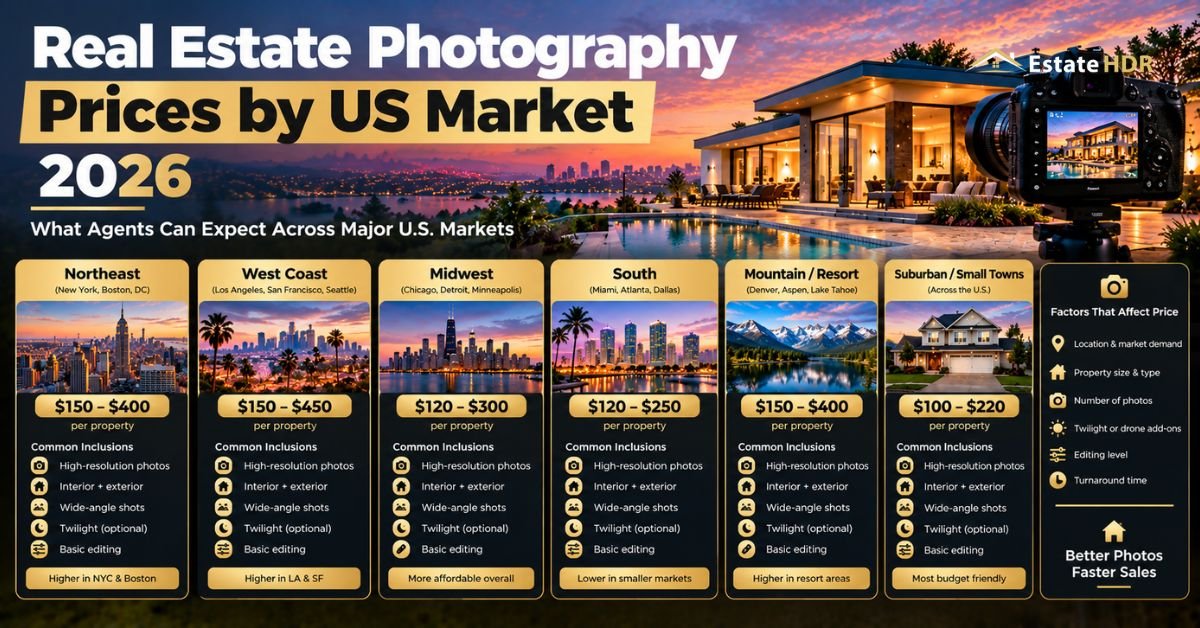
Two identical three bedroom houses. One sits in a county seat in Ohio. The other sits forty minutes outside Los Angeles. Same square footage, same shot list, same delivery deadline. The two invoices will not match. Real estate photography prices swing hard from metro to metro and most articles about it hand you a table of numbers with no source behind them. This one does something else. You get the forces that actually move the fee in your zip code, a way to measure them yourself in a single afternoon and the one line on the invoice that refuses to move at all.
Quick Answer at a Glance
Shooting fees are local. They track the median home price, how far apart the houses sit, how many photographers chase the same listings and how many usable daylight hours the season gives you. Editing fees are national. Post production is billed per image and never leaves a hard drive. One published rate covers Boise and Brooklyn alike.
Three Terms Worth Getting Straight
- Market rate: the fee a working photographer in your metro can quote on a normal Tuesday and still win the booking. Not the highest price anyone ever charged. Not the cheapest listing on a classifieds board either. It sits in the fat middle of what agents pay week after week.
- Access time: every minute between arriving at the property and taking the first frame. Gate codes, lockbox trouble, a doorman calling upstairs. This time is paid for whether or not anyone writes it on the invoice.
- Drive-time radius: the ring around a photographer's home base where a job stays profitable without a travel surcharge. In a compact metro that ring holds plenty of houses. In a sprawling one it holds very few.
The Money Drivers: Home Value and Who Else Is Shooting
Start with the median home price band. It sets the ceiling on everything else. A listing agent works on commission. Marketing spend on one property is a slice of an expected payday. Double the payday and the slice can double too. That is why the same forty photo package is an easy yes in one county and a hard argument twenty miles away.
- Competition decides where inside that ceiling the number lands. Count the shooters. A metro with two hundred listing photographers behaves nothing like a metro with twelve. In the crowded one, floor plans get thrown in free and somebody is always undercutting the entry tier. In the thin one, one reliable shooter holds a firm price for years.
Brokerage structure matters more than people expect. Where large franchises dominate, photography is often bought centrally and agents never see a menu. Where independents dominate, every agent shops alone and prices spread out. A market can look expensive on paper and still be hard to earn in.
The Clock Drivers: Miles, Gates and Daylight
Everything else that moves the shooting fee is really a fight over the calendar. A photographer sells days, not photos.
Sprawl is the big one. In a dense metro a shooter might stack four jobs before lunch. In a spread out sun belt metro those same four jobs eat a whole day in the car. Fewer jobs per day means each job carries more overhead. The quote rises to match. Travel tiers show up because a flat citywide price rarely survives the suburbs.
Access friction is the quiet killer. Gated communities want a call ahead. Some HOAs want written notice before a commercial camera comes through. Doorman buildings want a certificate of insurance on file. In the densest cities, street level work drags in permit questions, loading zone rules and hourly parking. None of that shows up in a portfolio. All of it shows up in the price.
Then there is light. A December afternoon in Minneapolis gives a fraction of the window a June afternoon does. Twilight sessions up north shrink to a slot one crew can fill per evening. Southern markets trade that for heat, storm season and glare. Listing volume is itself seasonal, which stacks on top.
HDR Photo Editing Service Snapshot
Full specs, bracket handling and the three tier quality check sit on the HDR photo editing service page.
Real Estate Photography Prices Split Into Two Lines
Split any listing media bill in half and you get two different animals. The shooting line pays for a person, a car and a block of daylight in one place. The editing line pays for pixels moving through a pipeline with no address. Only one can be priced by geography.
Here is the second line, published openly instead of buried inside a package.
"Notice what is missing. No travel tier. No parking. No winter surcharge. No premium for a bigger house, because a bigger house just means more frames at the same unit price. "
Research Your Market Rate in One Afternoon
Nobody publishes a trustworthy per metro rate table. The ones floating around online are usually sampled from whoever bought ads that quarter. You can do better in three hours with a browser and a phone. The number is out there. It is just scattered.
Four places hold real data. Brokerage preferred vendor pages often name a media partner with public packages, which tells you what a whole office already agreed to pay. Local photographer sites with a visible order form are the cleanest signal, because that price is live and someone is defending it. Regional photographer groups argue about rates constantly and the arguing reveals the floor. Agents answer a straight question if you ask as a peer.
Read those sources with a filter on. Match square footage tiers, since a price for under 1,500 square feet tells you nothing about a 4,000 square foot quote. Check what the package includes. Twenty five images and no floor plan is not the same product as forty images, a plan and a reel. Ignore anything older than eighteen months.
Five Steps to a Number You Can Defend
Work through these in order and you will finish with a defensible figure rather than a guess.
List every active photographer inside a thirty minute drive of your main coverage area. Pull the ones with a public price. Ten is plenty.
Write each package into one sheet with four columns: square footage tier, image count, what is included and the price. Convert everything to a price per delivered image so the packages become comparable.
Drop the highest two and the lowest two. The extremes are usually a luxury specialist and somebody buying market share at a loss.
Take the middle of what is left. That is your market rate for a standard job. Add a travel tier beyond your profitable drive-time radius and a seasonal note for your darkest months.
Call three listing agents in your area and read them the number. If nobody flinches, you are under. If everyone flinches, check your image count against local habit.
How Estate HDR Handles the Editing Half
- Submit: upload full bracket sets or single frames in any accepted RAW or JPG format through the client portal, with a short note on the look you want.
- Produce and QA: editors blend the exposures by hand, mask the windows, correct color and perspective, then a three tier review checks every frame before it leaves.
- Delivery: files come back in 12 to 24 hours, print JPG plus a web sized MLS JPG, with rush turnaround available when a listing goes live the next morning.
See the delivered work on the before and after portfolio, then run a free first order on a real bracket set before committing anything.
Why the Editing Line Is Flat Coast to Coast
This is the part that surprises photographers who move cities. Your shooting fee is a local negotiation that resets the moment you cross a county line. Your editing cost does not reset. It is priced per image against a published rate and stays indifferent to where the camera stood.
That has three practical effects worth thinking about.
- A photographer relocating from a cheap market to an expensive one keeps the same cost of goods and gains a higher sell price. Margin per job jumps with no change to the workflow. The reverse hurts. Move to a thin rural market and the sell price drops while the per image cost stays put. Volume has to close that gap.
- Covering several metros gets an even cleaner benefit. One vendor, one rate card, one turnaround promise. Quote a Phoenix job and a Tucson job with different shooting fees and identical post production costs. Mixed vendors across regions is where margins get lost.
- An agent comparing two quotes in two cities can strip the editing portion out of both and compare only the local half. That is the honest comparison.
What the Fixed Half Costs
Post production runs from $0.80 per photo for HDR and flambient work, with volume tiers cutting that to $0.76 at twenty or more photos, $0.72 at fifty and $0.68 at a hundred. Virtual staging starts at $8.00 per image with unlimited revision rounds and a library of more than 5,000 furniture pieces. Every current tier sits in the published pricing block.
Put that against a shooting fee and the shape becomes obvious. A forty image interior set costs a fixed and knowable amount to edit anywhere in America. The rest of the invoice is your metro talking.
"Rates, tiers and included services are listed openly on the pricing section rather than quoted per market, which is the whole point. "
Take a photographer who spent six years shooting in a Midwest metro then moved to a coastal one. Her old package price would have looked absurd in the new market. Far too low. She nearly repeated it out of habit. She ran the afternoon method instead: eleven local shooters, four with public prices, three brokerage vendor pages and two phone calls. The middle of that set sat well above her old number. Her per image editing cost had not moved by a cent. Same $0.80 line, same turnaround, same file formats. She raised the shooting fee to the local middle and her margin per listing roughly doubled inside a quarter.
About the author
The Estate HDR Team edits listing imagery for photographers and brokerages in every US market, from solo operators to offices running hundreds of listings a month. The team has processed more than a million property photos for 500+ agencies. Estate HDR was founded in 2020 and its production, retouching and quality leads are named on the studio team page. The studio profile sits on the About Estate HDR page.
Price the Local Half, Fix the National Half
Stop hunting for a national answer to a local question. Real estate photography prices are set street by street on the shooting side. No table online knows your drive times or your December daylight. Work them out with the afternoon method above. Then hold the other half steady, because per image editing does not care what your rent costs. Estate HDR publishes those rates openly and gives a free first order so you can test quality before any money changes hands. Volume tier questions go to info@estatehdr.com or through the contact page. For what actually happens to your brackets after upload, read our full walkthrough of HDR real estate photo editing.
Frequently Asked Questions
Does a bigger house always cost more to photograph?
Almost always on the shooting side. Most photographers band their packages by square footage because a 4,000 square foot home takes longer to walk, longer to light and produces more frames. The bands are wide. A 2,100 square foot house and a 2,400 square foot house often land in the same tier. Ask where the band edges sit before you book. A house sitting just over a line can cost a lot more than one just under it.
Who pays for listing photos, the agent or the seller?
In most US transactions the listing agent pays and treats it as a marketing cost recovered from commission. Some brokerages centralize it and bill the agent internally. A smaller number of sellers pay directly, usually on luxury listings where the marketing plan is negotiated line by line. Flat fee and discount brokerages sometimes pass the cost to the seller as an add on. Ask at the listing appointment rather than assuming.
How is a travel fee usually calculated?
Two common ways. Some photographers set a free radius around their base and then charge a flat surcharge per zone beyond it, often in fifteen minute drive-time bands. Others charge per mile past a set distance. Toll roads, ferries and paid parking are usually billed at cost on top. Ask for the free radius in minutes rather than miles, since twelve miles across a dense city and twelve miles on a highway are not the same trip.
Is drone coverage priced separately?
Usually yes. Aerial work needs a certified remote pilot under FAA Part 107 rules, separate equipment and an airspace check before takeoff. Some properties sit in controlled airspace where authorization takes extra time. Most photographers quote it as an add on rather than folding it into the base package. Weather cancels drone work more often than interior work, which is another reason it stays on its own line.
How long should listing photos take to come back?
Same day to two business days is the normal range for edited stills across the country. Rush options usually exist for an extra fee when a listing goes live the following morning. Floor plans and video generally take longer because they involve a separate production step. Agree the delivery time in writing before the shoot. A photographer who is vague about turnaround is often the one juggling a backlog.
Do I own the photos I paid for?
Not automatically. Under US copyright, the photographer owns the images unless a written agreement transfers rights or grants a license. Most listing work is delivered under a license limited to marketing that one property for that one agent. Reusing the photos after the sale closes usually needs fresh permission. Handing them to the next agent does too. Read the license clause. It is short and it decides a lot.
Are twilight sessions more expensive than daytime ones?
Yes, on the shooting side. The usable window runs roughly twenty to forty minutes. A photographer can serve only one property per evening and prices accordingly. Weather can cancel it outright. Virtual twilight solves the same problem in post at a fixed per image rate with no scheduling risk, which is why many teams shoot in daylight and convert afterward. Both routes end up in a listing gallery.
Does a rush order cost more?
On the editing side, usually a modest uplift for a shortened turnaround. On the shooting side, a same day or next morning booking can cost more because it displaces something else on the calendar. If your launch dates are predictable, book the slot early and skip the surcharge. Rush pricing exists to price scarcity rather than to punish you. Planning removes most of it.
Should I pay per photo or buy a package?
Packages win for standard listings because the photographer can plan the day around a known scope. Per photo pricing makes sense for unusual jobs: a single hero shot, a re shoot of two rooms, a commercial space with an odd list. Watch the image count inside a package. A cheap package with twenty images can cost more per usable photo than a dearer one with forty.