By Estate HDR Team | Published: Nov 2026
Sunset is at 6.41pm. The photographer has twenty usable minutes. The seller was told to turn the lights on and turned on three of them. It is clouding over from the west.
That is a twilight photoshoot real estate shoot in practice. It produces the best exterior frame in the business when it works. This is an honest look at what it costs when you count everything.
Quick Answer at a Glance
| Question | Real shoot | Conversion |
|---|---|---|
| What you get | Genuine light, correct reflections | A close imitation built from a daylight frame |
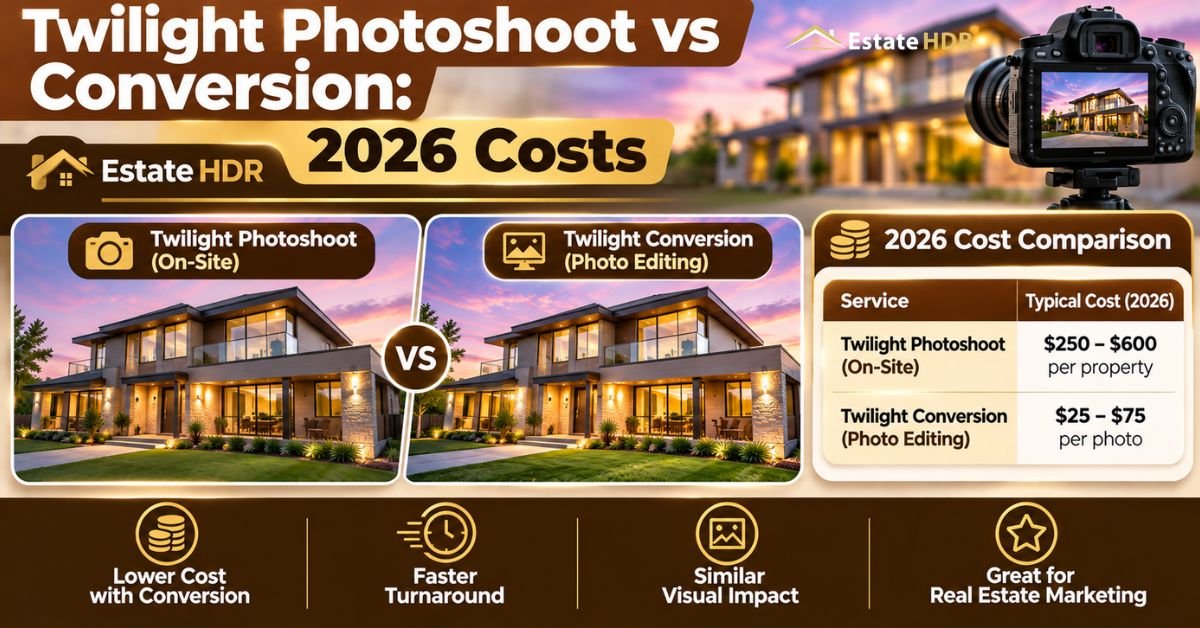
| Cost shape | A second site visit | Per photo. $6.00 twilight, $4.00 day to dusk |
| Weather risk | High. Reschedules are common | None |
| Shooting window | About twenty minutes | Any daylight frame |
| Seller involvement | Must prepare the house that evening | None after the day shoot |
| Disclosure | Not required | Required in most markets |
| Best for | Flagship properties with designed lighting | Almost everything else |
What a Real Shoot Actually Involves
The shooting is the short part. Everything around it is the cost.
A separate trip to the property, timed to a sunset that moves through the year. Setup before the light arrives, since there is no time to work out angles once it does. Twenty minutes of actual shooting. Then the drive home in the dark.
The seller has to be briefed a day ahead and present on the evening. Lights on in every room, blinds open, cars moved, landscape lighting switched on at the meter rather than left to a timer that fires at nine.
Then the weather. Cloud removes the blue. Rain removes everything. A hazy evening produces a flat grey sky where the gradient should be.
"The craft side of getting it right is covered in the twilight photography guide. It is a genuinely skilled shot and worth learning. "
The Reschedule Problem
This is the cost photographers feel most and clients never see. A rescheduled twilight visit is not a postponed task. It is a second evening blocked out, another drive, another conversation with a seller who has now prepared the house twice. Two reschedules on one listing and the frame has cost more than the entire rest of the shoot.
Photographers who sell real twilight work price a reschedule allowance into the fee. That allowance is invisible to the client, who then compares the figure with a per-photo conversion rate and assumes the photographer is expensive.
What Each Route Costs
The comparison is awkward because the two are priced in different units. A conversion is a fixed number per frame. Estate HDR lists virtual twilight service page work at $6.00 per photo and day to dusk conversion at $4.00 per photo, on a 24 hour turnaround. Rates sit on the published pricing block.
A real shoot is priced as a visit. Count the components rather than a headline figure: travel both ways, setup time, the shooting window, the reschedule risk and the evening itself, which is time that cannot be sold to anyone else.
For a single frame on a standard listing, the arithmetic is not close. For a flagship property where the marketing budget supports it, the visit is a small line item and the result justifies it.
Can Buyers Tell the Difference
On good work, rarely. On poor work, immediately.
- The tells are consistent. Windows all glowing the same flat orange, with no sense of rooms behind the glass. A daylight-bright building sitting under an evening sky. Lawn and driveway still reading green and grey while everything above them went blue. Landscape lighting that the property does not have.
- Each of those comes from a conversion that stopped at the sky. A full conversion darkens the scene, lights windows individually, rebuilds reflections on driveways and pools, then grades the whole frame.
Finished examples are in the twilight examples. The six step production sequence is in virtual twilight explained.
Where the Real Shoot Genuinely Wins
Worth being specific rather than diplomatic. Reflections are the clearest case. A pool holding the real sky, glass doors reflecting a real garden at dusk, wet paving catching window light. All three can be rebuilt. None are rebuilt perfectly.
Interior visibility through glass is the second. In a genuine twilight exposure you see into the rooms, with furniture and depth. A conversion adds glow to the glass, which reads correctly at a glance and less well at full size.
Third is the overall coherence. Real light falls on everything at once. A conversion assembles the same effect decision by decision and on a complicated building some of those decisions will be slightly wrong.
Which Properties Justify the Visit
Three categories and they overlap.
- Homes with a designed lighting scheme, where switching it on is the point.
- Properties with pools or water features, which reflect.
- Architectural houses with large glazed areas, where the interior becoming visible at dusk is the strongest thing about the building.
Outside those three, a conversion delivers most of the effect at a fraction of the cost and with none of the scheduling pain.
Running a Real Twilight Shoot Properly
If you are going to do it, the preparation decides the outcome.
- Scout in daylight. Decide the angle before the light arrives.
- Send the seller a preparation list a day ahead, not an hour ahead.
- Arrive forty minutes before sunset. Set up, meter, frame.
- Shoot a sequence as the light falls rather than waiting for one perfect moment.
- Keep shooting past the point it looks too dark. The best frame is often later than it feels.
- Check the lights are all on before the light goes, since nothing can be fixed afterwards.
Point two is the one that fails most often. A seller given fifteen minutes notice will miss half the lamps in the house.
The Frame Is Doing One Job
Both routes exist to produce the same thing, which is worth stating before comparing them.
- A portal shows listings as a grid of small images. Nearly all of them are daylight exteriors under pale sky. A lit house at dusk is the only warm point in a cool field so the eye lands on it without the viewer choosing to.
- That is the entire mechanism. Everything else, the craft, the reflections, the gradient in the sky, serves the moment a stranger scanning a grid stops moving.
Which means the frame has to work at thumbnail size first and at full size second. A technically beautiful twilight exposure that reads as a dark rectangle in a grid has failed at its actual job. Judge both routes on that test rather than on fidelity. A conversion that reads clearly beats a real shoot that was taken ten minutes too late.
Scheduling Twilight Around a Working Week
The calendar problem is worth setting out, since it is what pushes most photographers toward conversions. Sunset moves. In midsummer a twilight shoot lands late enough to end the working day well after dinner. In midwinter it collides with the afternoon, which is also when daytime shoots are booked. Neither extreme fits a schedule built around daylight work.
Then there is travel. A twilight visit to a property forty minutes away consumes more than two hours once both drives are counted. Two such visits in a week is most of a working day spent on single frames. Batching helps a little. Two listings in the same area on one evening is workable if the properties are close and the seller preparation holds. Beyond two, the light runs out.
A twilight photoshoot real estate booking also cannot be moved by an hour the way a daytime appointment can. The window is fixed by the sun, which makes it the least flexible appointment in the week.
What to Tell a Seller Who Asks For One
Sellers see twilight frames on other listings and ask. The conversation goes better with a prepared answer.
"Start with what it achieves: one standout frame that performs in the thumbnail grid. Not a gallery, one frame. That reframes the request before the cost comes up. "
Then give them the two routes honestly. A second evening visit with their cooperation and a weather risk or a conversion from the daylight shoot delivered the next day with a disclosure line.
Most sellers pick the conversion once they understand they would need to be at the house that evening with every light on. The ones who pick the real shoot usually have the kind of property that justifies it, which makes the conversation self-selecting.
A Hybrid That Works
Most working photographers end up here rather than at either extreme. Shoot the full daylight set as normal. Convert one frame for the hero image. Reserve real twilight shoots for the two or three listings a year where the property genuinely earns a second visit.
That keeps the schedule sane, gives every listing a standout frame and spends the evening trips where they produce a return. Estate HDR sees this pattern in the order flow, with conversions on routine listings and photographers shooting live twilight only on their flagship work.
Disclosure Is the Real Difference
The honest advantage of a real shoot is that nothing was altered so nothing needs labelling. A conversion is a materially altered image in most markets, which means a caption line. That is the entire extra obligation. One line of text against a second evening of work.
Framed that way, the choice is usually easy. Keep the real shoots for the properties that deserve them and let one disclosed frame do the work everywhere else. Budget a twilight photoshoot real estate visit the way you would budget any second trip, then spend it where the building earns it.
About the author
The Estate HDR Team finishes listing photography for photographers, agents and brokerage marketing staff across the United States, with more than a million photos processed for over 500 agencies. The studio was founded in 2020. Its production, retouching and quality leads are named on the studio team page. The company profile sits on the About page.
The Short Version
A twilight photoshoot for real estate buys light that behaves correctly, at the cost of a second visit and a weather gamble. A conversion buys reliability at a fixed per-photo rate. Flagship listings justify the visit. Everything else is better served by one converted frame delivered overnight. Estate HDR converts at $6.00 per photo on a 24 hour turnaround. Start with a free first order or email info@estatehdr.com.
Frequently Asked Questions
How much does a twilight photoshoot cost?
A real twilight shoot is usually priced as a second visit, since it cannot be combined with a daytime session. Expect travel, setup and a short shooting window. Digital conversion is priced per photo instead. Estate HDR publishes virtual twilight at $6.00 per photo and day to dusk at $4.00 per photo, both on a 24 hour turnaround.
What time is twilight for real estate photography?
Roughly twenty minutes either side of sunset, with the best window often starting a few minutes after the sun has gone. Earlier and the sky is still bright enough to make lit windows invisible. Later and the sky goes black, which kills the blue that makes the frame work. The window is short and it moves through the year.
Is a real twilight shoot better than virtual twilight?
A good real shoot is more convincing, because every reflection, shadow and glow behaves correctly without anyone deciding it should. It also needs clear weather, a second visit and a seller who remembers to turn on the lights. For a flagship property the real shoot wins. For most listings the conversion is the sensible trade.
How do you prepare a house for a twilight shoot?
Every interior light on, including lamps and anything under cabinets. Curtains and blinds open. Exterior and landscape lighting switched on at the meter rather than left on a timer. Cars moved. Bins out of sight. The seller needs this list a day ahead, since nobody can do it in the fifteen minutes before the light goes.
What camera settings suit a twilight exterior?
Tripod, low ISO and a series of exposures rather than a single frame, since the brightness range between a lit window and a dark garden is wide. Many photographers shoot a sequence as the light falls and blend the sky from an earlier frame with the building from a later one. The light changes faster than most people expect.
Can a twilight shoot be rescheduled if the weather is bad?
It has to be, which is the hidden cost. Cloud, rain or haze removes the blue sky the shot depends on. A rescheduled twilight visit means another trip, another evening and a listing waiting. Photographers who sell real twilight shoots usually build a reschedule allowance into the price for this reason.
How many twilight photos does a listing need?
One, usually the front elevation. The frame works because it stands out against daylight images in a portal thumbnail grid. A gallery full of twilight frames loses that contrast and starts to look artificial, since no buyer views a house at dusk in every room. Two is defensible where a property has a second strong elevation.
Do you have to disclose a virtual twilight photo?
Most MLS rule sets treat it as a materially altered image, which means a disclosure line in the caption or remarks. A real twilight photograph needs no disclosure, since nothing was altered. That difference is one of the few genuine advantages of shooting it live, though a caption line is a very low price to pay.
Which properties justify a real twilight shoot?
Properties where the exterior lighting is itself a feature: architectural homes with designed lighting schemes, houses with pools, properties with extensive glazing. At that level buyers expect production values and the second visit is a small part of the marketing budget. Below that, the conversion delivers most of the effect for a fraction of the cost.
Can you convert a photo if the house has no exterior lights?
Yes, though the result is quieter. Window glow does most of the work in a conversion and a house with large windows converts well even without landscape lighting. What should not happen is adding path lights or uplighters the property does not have, since that misrepresents the home to anyone who visits after dark.