By Estate HDR Team | Published: Nov 2026
A seller with a vacant house asks what staging will cost. The honest answer starts with a question back: how many rooms.
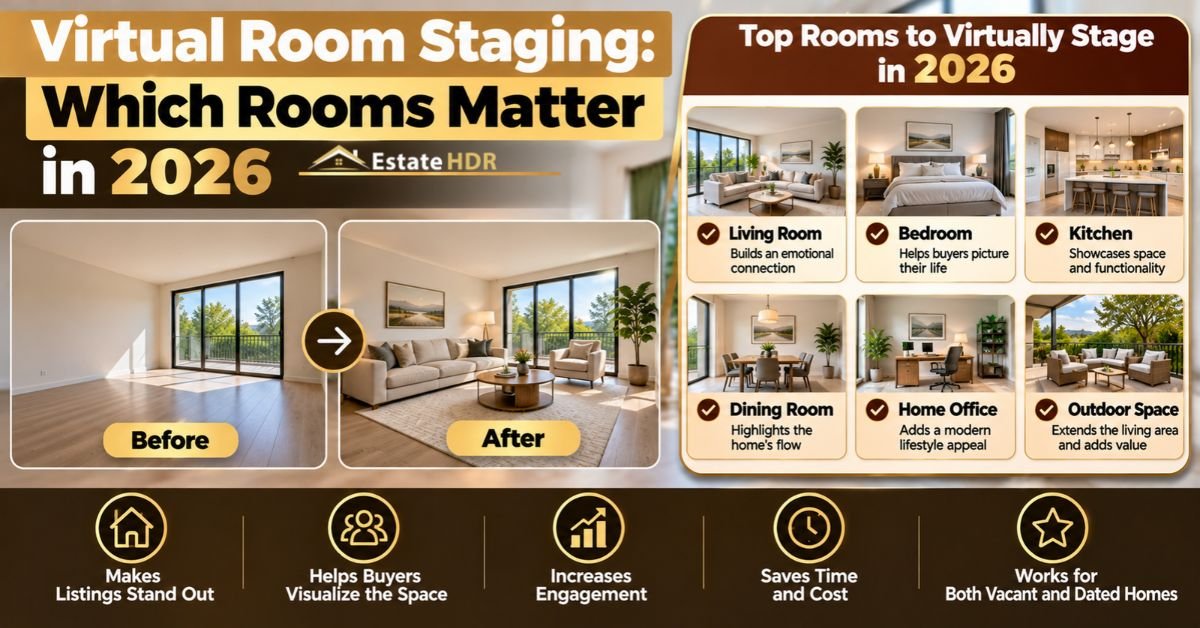
Virtual room staging is priced per room so the budget question is really a prioritisation question. Stage four rooms well and the listing works. Stage nine and the gallery starts to look like a furniture advert.
Quick Answer at a Glance
| Question | Short answer |
|---|---|
| How many rooms | Three to five. Three covers the decisions buyers actually make |
| First room | Main living space, in almost every market |
| Second | Primary bedroom |
| Third | Dining area, especially in open plan homes |
| Usually skip | Bathrooms, kitchens, hallways, utility rooms |
| Rate | $8.00 per room, unlimited revisions, 24 hour turnaround |
| Disclosure | Required in most markets. One caption line |
The Four Rooms That Matter
One: the main living space
This is the frame that sets the scale for the entire house. Buyers calibrate everything else against it, which is why an empty living room makes the rest of the gallery harder to read. It is also usually the second image in a listing, straight after the exterior. If a single room gets staged, this is it. No market disagrees.
Two: the primary bedroom
Buyers have one question here and furniture answers it: does a real bed fit with room to walk around it. An empty bedroom looks generous and proves nothing. A staged one with a bed, two side tables and a chair settles the question before anyone books a viewing.
Three: the dining area
Most valuable in open plan homes, where an unfurnished space reads as a corridor between the kitchen and the living room.
A table with chairs defines the zone. Without it, buyers struggle to see where a family would eat, which is a surprisingly common objection on modern layouts.
Four: the awkward room
Every house has one. The small third bedroom, the odd space off the landing, the room with a sloped ceiling. This is where staging earns the most per dollar, because it converts a question into an answer. Stage it as what you want it read as: a bedroom, a study, a nursery. Buyers rarely imagine a use on their own. Finished examples by room type sit in the staged examples.
The Rooms Worth Skipping
Suppliers rarely volunteer this list so here it is.
| Room | Stage it | Why |
|---|---|---|
| Bathroom | No | Fitted rather than furnished. Nothing to add but towels |
| Kitchen | Rarely | Units already give scale. Light styling is enough |
| Hallway | No | Nobody buys a house for the hallway |
| Utility room | No | Function is obvious without furniture |
| Secondary bedroom | Sometimes | Only when the room is small enough to be doubted |
| Garage | No | Buyers measure it rather than picture it |
| Patio or deck | Sometimes | Where outdoor living is part of the pitch |
The money saved on those seven rooms pays for better work on the four that matter.
Budget Tiers That Make Sense
Three sensible packages, built from the priority order.
| Tier | Rooms | Suits |
|---|---|---|
| Minimum | Living room only | A property that is otherwise furnished or very small |
| Standard | Living, primary bedroom, dining | Most vacant family homes |
| Full | Those three plus the awkward room and a patio | Larger vacant homes, higher price points |
At $8.00 per room on the virtual staging service page, each tier is a predictable number before the order is placed. Rates sit on the published pricing block.
Notice what is not in any tier. Nine rooms. There is no version of this where staging the whole house is the right answer on a normal listing.
Shooting the Rooms You Plan to Stage
Staging quality is decided by the photograph underneath it.
- Shoot from the room corner at chest height. Floor level exaggerates and doorway level flattens.
- Keep verticals straight. Furniture placed into a leaning frame never sits right.
- Include the whole floor. Furniture needs floor to stand on.
- Avoid the widest lens setting, which stretches the far wall and shrinks any furniture added later.
- Shoot the room genuinely empty. One chair left behind has to be removed before anything is added.
Longer version in the staging photo brief. Five minutes on the day saves a revision round.
Why Room Order Beats Room Count
Two agents spend the same money on staging. One gets viewings. The difference is usually the order rather than the amount.
Buyers move through a gallery in sequence and they decide early. The first interior frame does most of the work, the second confirms it and by the fourth they have either booked a viewing or moved on. Staging rooms that appear late in the gallery spends money after the decision has been made.
So the rule is simple. Stage the rooms that appear first, then reorder the gallery so the staged ones lead. A staged third bedroom sitting at frame nineteen helps nobody. This also means the gallery order itself is worth five minutes of attention. Exterior, main living space, kitchen, primary bedroom, then everything else. That sequence matches how buyers think rather than how the photographer walked the house.
What Happens If You Stage Nothing
Worth looking at the alternative honestly, since plenty of vacant homes sell without staging. An empty house sells. It sells to buyers who can read a floor plan and picture furniture, which is a smaller group than agents assume. Everyone else scrolls past a gallery of bare rooms because nothing in it holds attention.
The cost shows up as scroll speed rather than as a lost sale. Empty rooms give the eye nowhere to rest so the listing gets two seconds instead of eight. Fewer saves, fewer enquiries, more time on market.
It also shows up at the viewing. Buyers walking an empty house frequently underestimate room sizes, because there is no reference object. Agents then spend the viewing explaining that a bed does fit, which a staged photo would have done for free.
"None of that argues for staging nine rooms. It argues for staging the three where the misreading happens. "
Staging Against the Price Point
The right amount of furniture changes with the listing price, which surprises people who expect one formula.
Below the local median, buyers are checking whether their own life fits. A full, normal arrangement helps: sofa, coffee table, side tables, a rug, something on the walls. The room should look lived in.
Well above the median, buyers are reading the architecture. Fewer and larger pieces serve better, with more empty floor. Crowding a high end room with furniture makes it look smaller, which is the opposite of the intent.
Mid market sits between the two and forgives either approach. When in doubt there, follow the lower price point. A room that looks liveable never loses a buyer. A room that looks like a showroom sometimes does.
"Estate HDR takes the price point as a line in the order notes for exactly this reason, since the same room gets staged differently depending on it. One line in the brief prevents the most common revision request. "
Choosing the Style Once
Pick one style family for the whole order rather than per room.
A house staged modern downstairs and farmhouse upstairs reads as two properties. Consistency across the staged rooms matters more than the style itself, which is a relief when a seller has opinions. How to pick the family from the architecture is covered in the furniture style guide.
The Occupied Home Question
Sellers in residence ask for staging constantly. Two different jobs sit behind that request. Where the furniture is dated, oversized or simply too much, the room has to be emptied digitally before anything new goes in. That is two operations and it is priced as two. Where the room is fine but cluttered, item removal at $2.00 per photo is the cheaper and usually better answer. Clear the surfaces, keep the furniture.
The best option costs nothing. Ask the seller to move the furniture out before the shoot where that is practical. A genuinely empty room is cheaper to stage and the result looks better.
Disclosure in One Line
Most markets treat a staged photo as materially altered, which means a caption line. Sellers sometimes worry it undermines the image. It does not. The buyer who books a viewing is coming for the rooms rather than the sofa and the agent who disclosed has nothing to explain at the door.
A Four Room Order, Start to Finish
What the process actually looks like, since first time buyers of staging usually lose a day to uncertainty.
- Shoot the four rooms empty, finished and straightened.
- Send full resolution files in one folder, named by room.
- Name the style family in one line, plus anything that must stay in frame.
- Review what comes back inside 24 hours. Request changes if the style misses.
- Add the disclosure line to each staged frame before upload.
Five steps, one working day. The part that goes wrong is step three, where a vague brief produces a style nobody asked for.
About the author
The Estate HDR Team finishes listing photography for photographers, agents and brokerage marketing staff across the United States, with more than a million photos processed for over 500 agencies. The studio was founded in 2020. Its production, retouching and quality leads are named on the studio team page. The company profile sits on the About page.
The Short Version
Virtual room staging pays back fastest in the main living space, the primary bedroom and the dining area. Stage those three, add a fourth if the property has an awkward room that needs explaining, then stop. Estate HDR stages at $8.00 per room with unlimited revisions on a 24 hour turnaround. Start with a free first order or email info@estatehdr.com.
Frequently Asked Questions
How many rooms should you virtually stage?
Three to five on a typical home. Three covers the rooms buyers weigh most. Five is comfortable on a larger property. Staging every room produces a gallery that looks like a catalogue and buyers start to distrust it. The returns fall away quickly after the main living space, the primary bedroom and the dining area.
How much does it cost to stage a room virtually?
Pricing is per room rather than per property. Estate HDR publishes virtual staging at $8.00 per room with unlimited revisions on a 24 hour turnaround. A four room order is a predictable number rather than a quote. Compare that with physical staging, which is billed monthly and usually has a minimum term of several months.
Which room should you stage first?
The main living space. It is the first interior frame most buyers open, it sets the scale reference for the whole house and it carries the most weight in the decision to book a viewing. If budget allows only one room, that is the one. The primary bedroom comes second in almost every market.
Is it worth staging bedrooms virtually?
The primary bedroom, yes. Buyers check whether a real bed fits and whether there is room to walk around it. Secondary bedrooms matter less, except where the room is small enough that buyers doubt it qualifies as a bedroom. In that case staging it with a bed settles the question directly, which is worth the cost.
Should you stage bathrooms?
Rarely. Bathrooms are fitted rather than furnished so there is little for staging to add beyond towels and a plant. The frame is better served by good photography and a clean, decluttered space. Spend the staging budget on rooms where furniture changes how a buyer reads the size.
Do you need to stage the kitchen?
Usually not. Kitchens come with their own fittings, which already give the eye scale. Light styling such as a bowl of fruit or a stool at the island can help a bare kitchen feel used. Full staging rarely changes the decision, since buyers judge kitchens on the units and the layout rather than on the accessories.
Is virtual staging worth it on an occupied home?
It is a different job and it costs more, since the existing furniture has to be removed before anything is placed. Where the current furniture is simply dated or too large, removal and restaging can transform a listing. Where it is reasonable, leave it alone. The cheaper route on a cluttered but acceptable room is item removal rather than full staging.
Does virtual staging need to be disclosed?
Most MLS rule sets treat a virtually staged photo as a materially altered image, which means a disclosure line in the caption or remarks. Wording differs by market so check your own. The disclosure costs nothing and prevents the worst outcome, which is a buyer arriving expecting furniture that was never there.
Can you stage outdoor spaces virtually?
Patios, decks and balconies stage well, since furniture gives scale the same way it does indoors. A bare deck reads as small. The same deck with a table and four chairs reads as usable. Gardens respond better to other treatment such as clearing or grass correction. Pools and large open land are harder to stage convincingly.