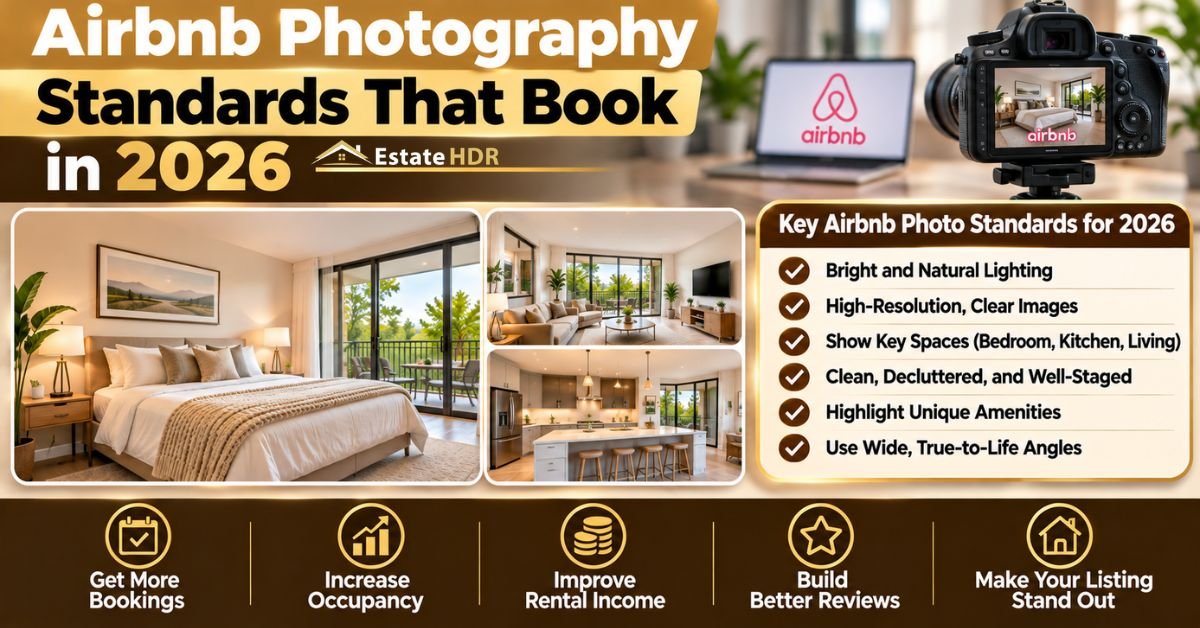
By Estate HDR Team | Published: Nov 2026
A sales listing lives for six weeks. A rental listing lives for years and earns from every booking it attracts. Same camera, same rooms, completely different economics. That difference should change how the shoot is planned. Most airbnb photography advice treats it as a sales shoot with fewer rules, which gets the priorities backwards.
Quick Answer at a Glance
| Question | Short answer |
|---|---|
| Cover photo | Main living space, daylight, one clear subject |
| Photos needed | Twenty to thirty. Completeness beats curation |
| Gallery order | By guest experience, not by walking route |
| Must include | Every bedroom, every bathroom, kitchen, parking, outdoor space |
| Never | Staging furniture that is not there |
| Editing standard | Balanced enough to survive heavy compression |
| Payback period | Years of bookings rather than one sale |
The Cover Photo Decides Everything
Guests do not browse listings. They scan a grid of thumbnails on a phone, giving each one about a second. The cover photo competes in that grid. It needs one clear subject, good light and enough contrast to read at the size of a postage stamp. A wide view showing an entire open plan floor becomes a grey smudge at thumbnail size.
Choose the main living space rather than the exterior. Guests are booking the inside. An exterior cover works only where the building itself is the attraction, such as a cabin or a converted barn. Look at your own listing on a phone before committing. If you cannot tell what the room is at thumbnail size, neither can a guest. Examples of room frames that hold up small are in the portfolio examples.
Room Order for a Rental Gallery
Sales galleries follow the house. Rental galleries should follow the stay.
- Main living space. The cover photo, repeated as the first gallery frame.
- Kitchen, wide enough to show the layout and the appliances.
- Primary bedroom.
- Remaining bedrooms in order of size.
- Every bathroom.
- Outdoor space: balcony, garden, patio, pool.
- Practical frames: parking, entrance, stairs, shared facilities.
- Detail shots: coffee setup, workspace, view from the window.
The last group is the one hosts skip and guests appreciate. A clear photo of the workspace books remote workers. A photo of the coffee machine answers a question nobody will ask but several will wonder about.
What Guests Check That Buyers Do Not
Property buyers look at space. Guests look at specifics, because they are committing money without a viewing. Bathrooms, in detail, because this is where bad surprises live. Kitchens in detail, because guests intend to cook. Beds, since the sleeping arrangement determines whether a group fits. Parking, which decides whether the stay is practical at all. Show all of it plainly. A missing bathroom photo reads as a bathroom with a problem, which is usually worse than the reality.
The Editing Standard That Survives Compression
Here is the part almost nobody accounts for. Booking platforms compress uploaded images heavily so pages load fast on slow connections. Compression attacks subtle gradients first. A photo that relies on gentle shadow detail or a delicate window gradient can lose exactly the thing that made it good.
So rental photos need a slightly more decisive edit than a print brochure would. Clean separation between tones, whites that are genuinely white, enough contrast to survive a second round of processing you do not control.
That is a finishing decision rather than a camera one. HDR and flambient editing balances the frame so it holds together after upload rather than only on your screen.
"Test it the easy way. Upload one frame, then view your own listing on a phone over a mobile connection. What you see there is what guests see. "
What to Clear Before Shooting
Rentals photograph best when they look ready for a guest rather than lived in by an owner.
- Remove all personal items. Photographs, mail, medication, laundry.
- Clear kitchen surfaces to two or three objects.
- Make every bed properly, with matching linen.
- Open all blinds and turn on every light.
- Hide bins, cleaning supplies, spare keys and anything with a code on it.
- Remove previous guest traces: used toiletries, half-burned candles, leftover food.
Anything missed can come out afterwards. item removal runs at $2.00 per photo, which is cheaper than returning to the property.
Photos as Expectation Management
Rental photography has a job sales photography does not: preventing complaints. Every gap between the photo and the room becomes a message, a refund request or a review. A listing that oversells converts better and then collects the reviews that stop it converting at all. That trade is bad in both directions.
The useful reframe is that a rental gallery is a promise you will be held to on arrival day. Photograph the small bathroom honestly and the guest who books it is happy with a small bathroom. Photograph it from the one angle that hides the shower and the same guest arrives annoyed.
This changes composition decisions. Shoot the room as it is used rather than from the corner that flatters it most. Include the ceiling height where it is low. Show the stairs if the stairs are steep.
"Estate HDR sees the consequence from the production side: hosts asking for a frame to be made brighter than the room, which is exactly the request that produces the review they are trying to avoid. "
The Seasonal Problem Nobody Plans For
A rental listing runs all year. The photos were taken on one day in one season.
- A beach property shot in July shows a bright terrace and open doors. In January the same listing attracts winter guests who arrive to grey skies and a closed-up terrace. Nothing was misrepresented. The expectation still missed.
- Two practical fixes. Shoot a small second set in the opposite season and swap the outdoor frames twice a year. Or keep the outdoor frames neutral enough to work in both, which usually means overcast light rather than brilliant sunshine.
- Indoor frames rarely need this. Rooms do not have seasons, which is another reason the cover photo should be an interior.
- Property managers running several units can batch this. One seasonal reshoot across a portfolio costs far less per unit than doing it one listing at a time.
Multiple Units and Visual Consistency
Managers with a portfolio have a problem single hosts do not: units photographed at different times by different people look like different businesses. Guests browsing two of your listings side by side notice immediately. One is warm and bright, the other cool and dim. The inconsistency reads as variable quality even where the properties are identical. The fix is a reference frame. Pick the best finished image from the portfolio, use it as the standard, finish everything else to match. New units join the standard rather than setting their own.
"Estate HDR runs portfolio accounts this way, treating every unit as part of one set rather than as separate jobs. It costs nothing extra and it is the difference between a brand and a collection of listings. "
Honesty Rules Are Stricter Here
- Sales listing photos are understood as a best version. Rental photos are a description of what a guest will receive, which is a different standard.
- A guest who arrives to find the room smaller, darker or furnished differently writes a review. That review stays visible to every future guest, which makes the cost permanent rather than one-off.
- So the usual staging tools do not apply. No added furniture, no removed permanent features, no lighting the property does not have. Correct the capture, clear the clutter, stop there.
What It Costs Across a Listing Life
The arithmetic is kinder here than anywhere else in property media. A thirty frame gallery finished at $0.80 per photo, with volume tiers listed on the published pricing block, is a small fixed cost. Spread across two or three years of bookings, the cost per stay rounds to nothing.
Compare that with a sales listing, where the same spend supports one transaction. Rental photography is the easiest case to justify in this whole industry, which is why it is strange how many listings still use phone snaps taken during a handover.
Shooting It Yourself
Plenty of hosts do and for a single unit it is a reasonable choice.
The capture rules are the same as any interior work: level camera, expose for the window, shoot from the room corner, avoid the widest lens. The phone photography guide covers them and the listing photography tips go further on composition.
The part worth outsourcing even when you shoot yourself is the finishing. It is the step that decides whether the gallery survives compression and it is the step hosts are least equipped to do.
Before You Publish
- View the listing on a phone, not a laptop.
- Check the cover photo reads clearly at thumbnail size.
- Confirm every bedroom and bathroom appears.
- Check nothing personal or identifying is visible, including door codes and mail.
- Confirm the photos match the current furniture. Replace any frame showing something no longer there.
Five minutes. The fifth item is the one that prevents the review nobody wants.
About the author
The Estate HDR Team finishes listing photography for photographers, agents and brokerage marketing staff across the United States, with more than a million photos processed for over 500 agencies. The studio was founded in 2020. Its production, retouching and quality leads are named on the studio team page. The company profile sits on the About page.
The Short Version
Airbnb photography rewards completeness over curation. Show every room, lead with the living space, keep the editing honest and remember that the file gets compressed before any guest sees it. Estate HDR finishes rental sets at $0.80 per photo on a 24 hour turnaround, which across years of bookings costs almost nothing per stay. Start with a free first order or email info@estatehdr.com.
Frequently Asked Questions
Do professional photos increase Airbnb bookings?
Guests compare listings in a grid of thumbnails so the cover photo decides whether yours gets opened at all. Professional images help most where the competition is dense and the property is otherwise similar to its neighbours. The effect compounds, since a rental listing works for years rather than weeks. That is a different payback period to a sales listing.
What should the Airbnb cover photo be?
The main living space, shot in daylight, bright and uncluttered. Not the exterior in most cases, since guests are booking the inside. Not the bedroom, which reads oddly as a first impression. The cover photo competes at thumbnail size against dozens of others so it needs one clear subject rather than a wide view of everything.
How many photos should an Airbnb listing have?
Twenty to thirty for a typical home. Cover the whole property: every bedroom, every bathroom, kitchen, living space, outdoor areas, parking and any shared facilities. Guests read missing rooms as hidden problems. Unlike a sales listing, completeness matters more than curation, because a guest cannot visit before booking.
Should you photograph short term rentals differently to sales listings?
Yes, in three ways. Rental guests want to see exactly what they get so the detail shots matter more. The cover photo is an interior rather than an exterior. And the gallery is ordered by the guest experience, starting where they will spend time, rather than by the route a photographer walks through the house.
Do you need to show the bathroom in rental photos?
Every bathroom, clearly. Bathrooms are the most common source of complaints and of booking hesitation. A clean, well lit bathroom photo removes doubt. Hiding it creates doubt. The same applies to kitchens, where guests check appliances in detail because they intend to cook.
How often should you update rental listing photos?
When the property changes and at least every two years. Furniture gets replaced, decor dates, seasons shift. Guests notice when the sofa in the photo is not the sofa in the room and a mismatch like that produces the kind of review that is hard to recover from. Reshoot after any significant refurbishment.
Can you use a phone for short term rental photos?
For a single room let in a quiet market, yes, especially with professional finishing afterwards. For a property competing in a dense market, the gap shows. Rental listings live for years so the cost per booking of better photography is very small. The decision is different to a sales listing that runs for six weeks.
Is virtual staging allowed for rental listings?
Platforms generally expect photos to show the property as a guest will find it. Staging furniture that is not there misleads the guest and generates refund disputes on arrival. Staging is for empty sales listings. For rentals, photograph the real furniture and use editing to make the space look its best rather than different.
What editing do rental photos actually need?
Exposure balancing so rooms are not dark, window recovery so views are visible, colour correction so whites are white, vertical straightening and removal of temporary clutter. Nothing that changes the property. Platforms compress images hard so a well balanced photo survives compression far better than one relying on subtle shadow detail.
How much does editing cost for a rental listing?
Per image, as with any listing. Estate HDR publishes editing at $0.80 per photo as the standard rate, with volume tiers from $0.60 on the first 24 images down to $0.45 at 100 or more. For a thirty photo rental gallery used across several years of bookings, the per-booking cost is negligible.