By Estate HDR Team | Published: Nov 2026
Most listing videos are too long, too fast and shot from too high. The pilot flew everything, the editor kept everything, the agent posted it and the average viewer left at twelve seconds.
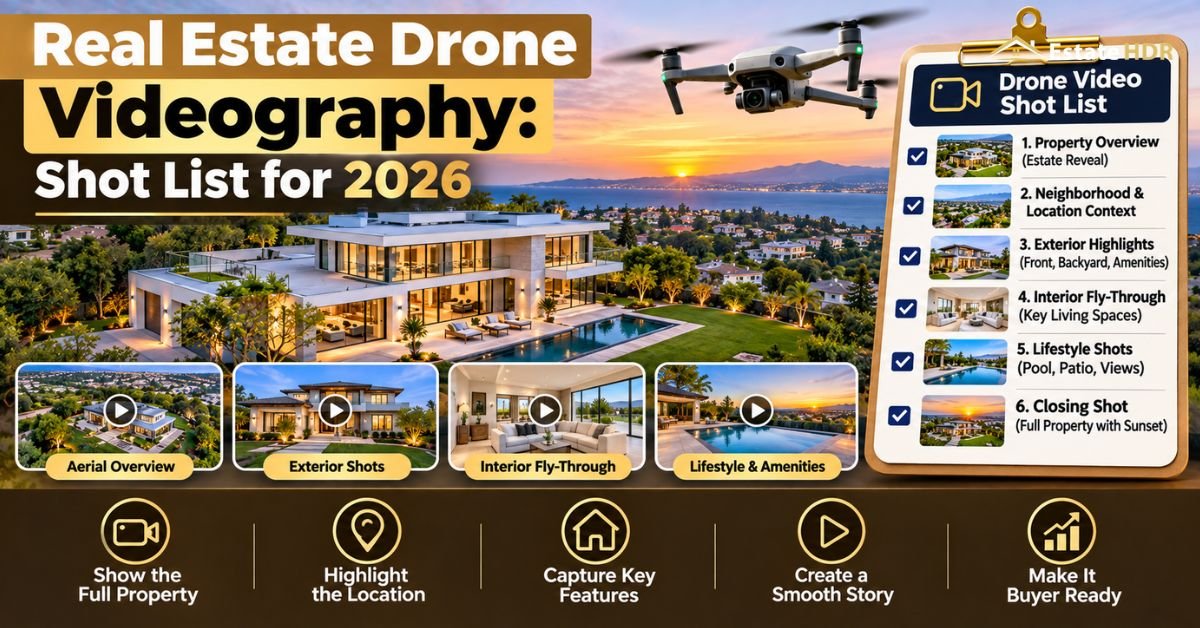
Real estate drone videography works when the flight is planned around what the edit needs. Five shots cover almost every property. The rest is discipline.
Quick Answer at a Glance
| Question | Short answer |
|---|---|
| Finished length | 60 to 90 seconds for a portal. 30 for social |
| Clips to shoot | Ten to twelve. The edit keeps five or six |
| The five shots | Reveal, orbit, push in, boundary pass, context climb |
| Movement speed | Slower than feels right in the air |
| Best light | Hour before sunset or bright overcast |
| Editing rate | $30.00 per video, 24 hour turnaround |
| Where it is wasted | Dense streets where the aerial shows neighbouring roofs |
Before You Fly
Checks, every time, regardless of how familiar the area is.
Certification and registration current. Airspace clear for the location and the time. Permission from whoever controls the land you take off from, which is not always the seller.
Licensing and airspace are covered properly in the UAV rules article. Treat it as the prerequisite rather than as background reading.
The Five Shots That Matter
The reveal
The property appears from behind something: a tree line, a ridge, the roof of the house itself. The aircraft moves forward and slightly up, revealing the building as it goes.
This is the opening shot in most finished videos because it does the thing an establishing shot has to do. It tells the viewer where they are and gives them a reason to keep watching.
The orbit
A slow arc around the building, keeping it roughly centred. Half an orbit is usually enough. A full circle takes too long at the speed it needs to be flown.
The orbit sells the relationship between house and plot. It is the shot that answers how big the garden is relative to the building.
The push in
Straight toward the front door, descending slowly, finishing at roughly head height.
This is the transition shot. In a combined video it is where aerial footage hands over to the interior walkthrough. Shoot it even when you are not producing interiors, since it makes a natural closing frame.
The boundary pass
A level flight along the property line at low altitude, showing where the land ends.
Buyers ask about boundaries more than almost anything else and a plan answers it abstractly where this shot answers it visually. On rural and large plot listings it is the most useful clip in the set.
The context climb
A steady vertical rise from above the house, revealing what surrounds it: a park, a coastline, a school, a town centre.
Use it only when the surroundings help. On a listing where the neighbours are the main thing visible, leave it out. A context shot that reveals a motorway is honest and unhelpful at the same time.
Still photography equivalents are covered in the drone photography guide.
The Flight Order That Saves a Battery
Shot order matters because batteries do not last and light changes.
- Context climb first, highest altitude, while the aircraft is freshest.
- Reveal next, since it needs the most attempts to get the timing right.
- Orbit third. Steady, predictable, forgiving of a slightly lower battery.
- Boundary pass fourth, low and slow.
- Push in last. It ends with the aircraft close to you, which suits a landing.
Flown in that order, a single battery usually covers a standard property. Flown randomly, the push in gets attempted on a low battery warning, which is how pilots end up with one usable take of the most important shot.
Flying for the Edit
Three habits make footage editable. All three feel wrong in the air.
Fly slower than instinct suggests. Aerial movement that feels sluggish on the controller reads as smooth and expensive on screen. Speed cannot be removed afterwards.
Start recording before the movement begins and stop after it ends. Editors need handles at both ends of a clip to cut cleanly and a shot that starts mid-movement cannot be used at the front of a sequence.
Hold the end of each shot for three seconds. That still moment is where a cut lands naturally.
Camera settings for aerial work sit in the drone settings post.
The Edit Sequence
Each cut in a listing video has a job. Ordering them by job rather than by what looks nice produces a clip people finish.
| Position | Shot | What it has to do |
|---|---|---|
| 0 to 8 seconds | Reveal | Establish the property. Earn the next ten seconds |
| 8 to 20 | Orbit | Show scale, plot and building together |
| 20 to 35 | Boundary or context | Answer the question the still photos cannot |
| 35 to 50 | Push in | Move the viewer toward the house |
| 50 to 80 | Interior walkthrough | Deliver the rooms |
| Last 5 | Pull back or static hero | Close on the strongest frame |
That structure holds at sixty seconds and at ninety. Below thirty seconds, drop the boundary and context shots rather than speeding everything up.
The Clip Nobody Watches to the End
Worth naming the common failure precisely, since almost every pilot produces it at least once.
It opens with a high wide shot of a rooftop. Then another high wide shot from a different angle. Then a slow orbit at the same altitude. Three shots in, the viewer has learned nothing they did not know from the first frame so they leave.
Altitude is the usual culprit. From high enough, every house looks like a rectangle with a garden. The information buyers want sits lower: the approach, the entrance, the relationship between the garden and the rooms that open onto it.
The fix is a rule rather than a technique. Change something between every shot. Altitude, direction or subject. If two consecutive clips could be swapped without anyone noticing, one of them is not needed.
"That single rule removes about half the length from most first drafts, which is why the finished clip gets watched. "
Shooting for Two Deliverables at Once
Every flight should produce a portal clip and a social cut. They are not the same video trimmed. A portal video is watched on a laptop by someone already interested. It can take eight seconds to establish the property. A social clip is watched on a phone by someone scrolling, who gives it about two.
So the social cut leads with the strongest frame rather than the establishing shot. Usually that is the reveal at its peak or the push in toward the door. Context and boundary shots rarely survive the cut at thirty seconds.
Framing matters too. A horizontal clip cropped to vertical loses the sides, which is where the building usually sits. Flying one or two shots with vertical cropping in mind costs a minute in the air and saves the social edit entirely.
Estate HDR produces both cuts from the same footage in one order, which avoids paying twice for a grade that has already been done.
Matching the Aerials to the Stills
The failure nobody plans for is colour. A buyer watches the video, then opens the photo gallery and the house is two different colours.
"Drone cameras and ground cameras render skies, greens and skin tones differently. Graded separately, they drift apart. Graded together, they belong to the same property. "
Finishing video and stills in one pass is the only reliable fix. HDR and flambient editing and the video edit run from the same reference frame when both come from one order.
What Editing Costs
Video is priced per finished piece rather than per clip, which makes the arithmetic simple.
Estate HDR publishes video editing at $30.00 per video on a 24 hour turnaround. Per-unit rates sit on the published pricing block. Examples are in the portfolio video showcase.
Against the time cost of grading, cutting and exporting a sixty second clip yourself, the comparison is not close for anyone shooting more than occasionally. The hour you spend on an edit is the hour that could have covered another shoot.
What the Finished Clip Should Look Like
Five tests on the export, before it goes anywhere.
When Not to Buy Aerial Video
Cases where the budget belongs elsewhere.
Dense terraced streets, where the aerial mostly frames neighbouring roofs. Apartments above ground floor, where there is no plot to show. Properties whose selling point is entirely interior, such as a renovated flat in a plain building.
In those cases, spend the same money on better interior finishing. Aerial footage of an unremarkable surrounding does not add information. It adds length.
About the author
The Estate HDR Team finishes listing photography for photographers, agents and brokerage marketing staff across the United States, with more than a million photos processed for over 500 agencies. The studio was founded in 2020. Its production, retouching and quality leads are named on the studio team page. The company profile sits on the About page.
The Short Version
Real estate drone videography is won in the flight plan rather than at the desk. Five shots, flown slowly, in an order that follows the battery. Then an edit that opens wide, moves closer and ends at the door. Estate HDR finishes listing video at $30.00 per video on a 24 hour turnaround, graded to match the stills from the same property. Start with a free first order or email info@estatehdr.com.
Frequently Asked Questions
How long should a real estate video be?
Sixty to ninety seconds for a portal listing. Thirty for social. Anything past two minutes loses most viewers before the end and the frames nobody watches are the ones you spent longest editing. Length should follow the property rather than a formula, though the ceiling holds everywhere. A large estate justifies ninety seconds. A two bedroom condo does not.
Do you need a license for real estate drone videography?
In the United States, any flight for commercial purposes requires a remote pilot certificate under FAA Part 107 and marketing a property is commercial. Aircraft registration and airspace compliance apply as well. Agents hiring a pilot should ask to see the certificate. The brokerage carries awkward exposure if an uncertificated pilot has an incident on a client property.
What drone shots sell a house?
The reveal, where the property appears from behind a tree line or over a roof. The orbit, which shows the building in context. The push in toward the front door, which is the shot editors use to transition indoors. The boundary pass, showing where the land ends. The context climb, showing what is nearby. Five shots cover most listings.
How much does drone video editing cost?
Editing is usually priced per finished video rather than per clip. Estate HDR publishes video editing at $30.00 per video on a 24 hour turnaround. Ask what a quote includes: colour grading, music licensing, titles, a vertical social cut. Those four are where quotes differ most and a cheap figure often covers the cut alone.
What settings should I use for drone video?
Shoot in a flat or log profile if the aircraft offers one, since it keeps grading options open. Use a frame rate that matches your delivery, with a higher rate only where you plan to slow a shot down. Keep movements slower than feels natural in the air. Almost every amateur aerial clip is flown too fast and speed cannot be removed in the edit.
Should listing video have music?
Yes, with a license. Unlicensed music on a listing video is a copyright exposure for the agent and the brokerage and platforms mute or remove clips routinely. Choose something unobtrusive. The music should not be the thing a viewer remembers, since the job of the clip is the property rather than the soundtrack.
Is drone video worth it for a standard listing?
It depends on what the aerial reveals. A home where the plot, the position or the surroundings are a selling point gains a lot. A terraced house on a dense street gains little, since the aerial mostly shows neighbouring roofs. Spend the budget on the properties where the view from above adds information rather than decoration.
Can you combine drone video with interior footage?
That is the standard format. Aerials open and close, interior walkthrough carries the middle, with the push in toward the door as the transition. The hard part is matching the grade between aerial and interior footage, since drone cameras and ground cameras render colour differently. Finishing both in one pass is the only reliable fix.
What is the best time of day to fly for listing video?
An hour before sunset gives warm, low light that models the building. Overcast light is flatter but far more forgiving, which matters because aerial footage has no fill light to rescue it. Avoid midday on a bright day, since the roof blows out and the shadows under eaves go black. Wind usually drops in the early morning and late evening.
How many drone clips do you need for one listing?
Shoot around ten to twelve usable clips. The finished video keeps five or six. Over-shooting is cheap in the air and expensive at the desk, since every extra clip is reviewed, named and considered. A tight shot list flown properly produces a better edit than forty clips of the same house from slightly different heights.